



For some families in Orange Farm, a food garden means more than fresh vegetables. It means one less meal they have to buy in a country where 14 million people face hunger.
Nonhlanhla Mazibuko, 30, says support from a local farming project, Intouch Youth Development & Community Justice, helped her household at a time when her family struggled to get by.
“I stay with my grandparents and I am unemployed. We survive on their monthly social grants, which are not enough,“ she says.
Mazibuko says her family received a much-needed food donation from a local organisation in December 2025.
“Although the donation was once-off, it came at the right time. The food parcel made a huge difference in my family, especially since it was festive [season],” she says.
Mazibuko says the organisation also helped them start their own vegetable garden.
“The organisation did not only give us vegetables but they also helped us to grow our own backyard garden. They gave us seeds to plant,” Mazibuko tells Health-e News.
“We started our garden on the day we received the donations. It has been growing well, because we are looking after it as we were taught.”
A wider hunger crisis
Mazibuko’s experience reflects a wider struggle in communities where unemployment is high and many families rely on social grants to survive.
That pressure is especially visible in Orange Farm. The City of Johannesburg’s 2025 Annual Economic Review says Region G, which includes Orange Farm, has the highest share of the city’s lowest-income households.
Last month, the South African Human Rights Commission held a national inquiry into South Africa’s food system to address the country’s growing food insecurity crisis. According to the commission, about 14 million people went to bed hungry in 2024, affecting roughly 22.2% of households and hitting poor and marginalised communities the hardest.
Health-e News has previously reported that food insecurity is also affecting people’s mental health. A 2024 study found that families often cope by eating cheaper, less preferred foods, skipping meals or, in some cases, begging for food.
Orange Farm community join hands with others
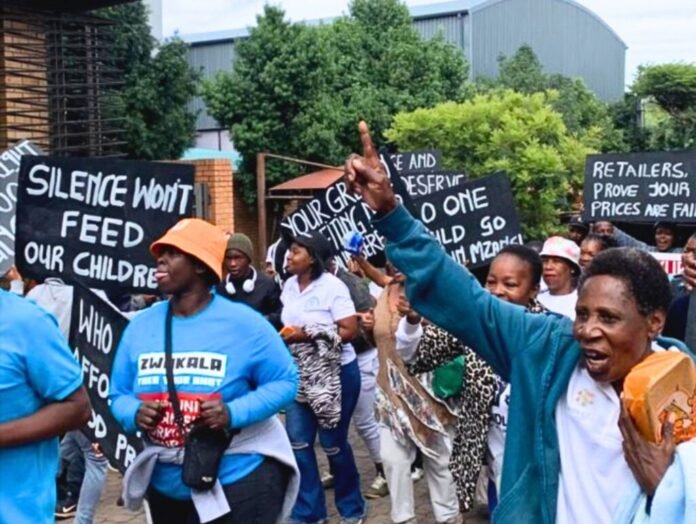
The issue of food insecurity is also being raised publicly by community groups. Last month, community members from Orange Farm joined others from across Johannesburg in a demonstration at the Nelson Mandela Foundation as the SAHRC inquiry got underway.
The protesters were led by a coalition of community-based organisations under the umbrella of Union Against Hunger.
Union Against Hunger, one of dozens of organisations that made submissions to the SAHRC, published its submission to the inquiry in early March.

Skills that can bring in income
For 20-year-old Ofentse Ndubiwa from Driziek 9, the Orange Farm gardening project offered something else: skills he says he can now use to make some money.
Ndubiwa says he was unemployed and not studying when he heard about the farming training on social media.
“I learnt crop maintenance and sustainable farming skills, with the skills that I have gained, I can now start my own backyard garden and keep it growing,” he says.
He says he is now trying to use those skills to earn an income.
“Currently, I am not working. However, I am using my skills to generate income by selling the crops from my backyard garden and planting for others and making money,” he says.
A local response to Orange Farm’s food needs
Intouch Youth Development & Community Justice says it began its food security work in Orange Farm after seeing the effects of poverty and hunger in the area.
Founder Ronney Kapaso says he first saw how serious the problem was while working in Orange Farm between 2013 and 2015.
“During this period I witnessed the level of poverty, unemployment, access to education and food insecurity,” he says.
The non-profit organisation, Intouch Youth Development & Community Justice, was started in 2016 to focus on food security initiatives in Orange Farm.
Hunger and mental health: study looks at how families cope with food insecurity
“We partnered with Gedion Mutshvangwa, who is currently the farm manager, and Ester Vatsha as the director. We then started a farm in 2016 on a small scale, which later grew to a large-scale production,” says Kapaso.
Kapaso says the aim is not only to donate food, but also to help people learn how to grow their own and build more sustainable livelihoods.
What the research says about food gardens
Research suggests backyard gardens can help households stretch food and lower some costs.
A 2025 South African study in Discover Food, based on 220 participants engaged in backyard gardening in the North West province, found that most households used all the land allocated to their gardens mainly to produce food for home consumption.
The study said backyard gardens can help families produce food more sustainably and save money that would otherwise be spent on buying food.
More than a once-off food parcel
Intouch Youth Development & Community Justice says it has trained more than 200 young people since it started in 2016 and has supported more than 100 families in and around Orange Farm with harvested produce.
For households like Mazibuko’s, the value of a food garden is not only in the vegetables it produces, but in the possibility of having something to rely on beyond a once-off food parcel.
And for young people like Ndubiwa, learning to grow food can also mean learning a skill they hope will help them survive. – Health-e News
*Additional reporting by Adel van Niekerk