



11/02/2026 – 16:12 GMT+1
Kazakhstan’s oil exports fell after Ukrainian drone attacks and stormy weather hampered operations at the Caspian Pipeline Consortium’s marine terminal in Novorossyisk. Its major oil field Tengiz also suffered an outage in January.
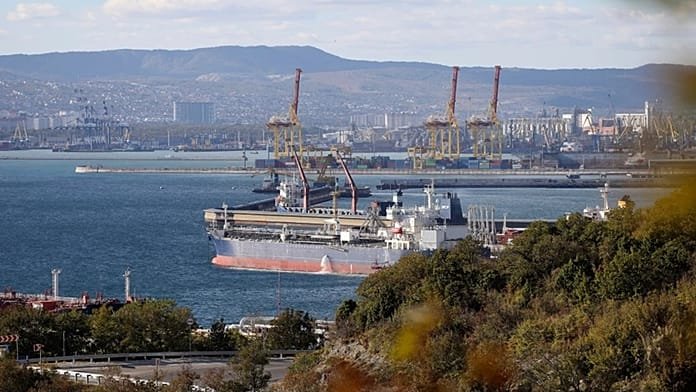
The Novorossiysk facility loads most of Kazakhstan’s oil onto tankers bound for European refineries.
On 29 November 2025, a naval drone attack disabled one of the terminal’s deep-water moorings (SPM-2), which has a loading capacity of up to 800,000 barrels per day.
On 13 January, drones then struck two tankers — Matilda and Delta Harmony — while they were waiting to load Kazakh crude.
Kazakhstan’s Energy Minister Erlan Akkenzhanov said the tankers were not part of Russia’s so-called shadow fleet.
“There were no restrictions imposed on the vessels, and they were not included on any grey lists.”
Authorities said both vessels were empty at the time. No injuries or oil spills were reported.
CPC pipeline
Kazakhstan ships about 80% of its crude through the CPC pipeline, making it one of the main routes for non-Russian oil supplies into Europe.
The pipeline runs from western Kazakhstan’s Caspian fields to Novorossiysk and carries production from the country’s largest projects, including Tengiz, Kashagan, and Karachaganak, operated by international energy companies such as Chevron.
Exports were also affected by a temporary outage at the giant Tengiz field earlier this year.
Disruptions tightened supplies of CPC Blend, a light, low-sulphur crude favoured by European refiners.
Reduced shipments therefore supported higher oil prices in Europe in January, with buyers forced to seek alternative grades.
European oil dependencies
Kazakhstan accounts for more than 12% of the EU’s oil imports and has long been viewed as a key partner in diversifying supply. In 2024, the country exported most of its 1.8 million barrels per day of production to Europe.
The Minister also commented on the financial impact of the oil losses as a result of the attacks.
“The oil has neither been transported nor sold yet. It will be sold at future market prices. Only after the transactions are completed will we have the full data and be able to report the numbers.”
Energy analyst Olzhas Baidildinov estimated Kazakhstan’s potential losses at around $1.6bn, assuming a benchmark price of $60 per barrel.
The attacks also triggered diplomatic tensions. Astana lodged a formal protest with Kyiv, calling the strikes acts of aggression against civilian infrastructure.
Ukraine said its actions were aimed at weakening Russia’s military-industrial capacity.
Currently, two of the CPC’s three moorings are operational. Repairs to the damaged unit have been slowed by bad weather, while two replacement moorings have been ordered from the UAE and are expected to arrive within 70 days.
The CPC system can transport more than 72 million tonnes of oil per year and counts Russia, Shell, Eni and other international companies among its shareholders.
Shutdown at Tengiz
Kazakhstan’s export disruptions were compounded by a shutdown at Tengiz, the country’s largest oilfield.
Chevron-led operator Tengizchevroil temporarily halted production at the Tengiz and nearby Korolev fields on 18th January after a fire at a generator caused a power outage.
The company has not provided further details on the cause.
Most Tengiz crude is exported through the Caspian Pipeline Consortium (CPC), and the operator declared force majeure on CPC Blend supplies following the incident.
Chevron describes Tengiz as the world’s deepest producing supergiant oilfield. It holds an estimated 11.5 billion barrels of recoverable reserves, though extraction is technically complex.
According to Energy Minister Erlan Akkenzhanov, the outage reduced output by around 7.2 million barrels. He said the lost volumes would be recovered later and annual production targets would remain unchanged.
Tengiz has capacity of up to 900,000 barrels per day, but was producing about 360,000 barrels daily before the shutdown.
The operator said the field’s power distribution system has since restarted, with output being restored in stages.
Chevron is investing $48bn (€40.45bn) in an expansion project aimed at raising production to nearly one million barrels per day — close to 1% of global supply. However, export bottlenecks have slowed those plans.
The disruption also raised concerns about regional energy security. Tengiz supplies associated gas to the Mangistau and Atyrau regions, which is used for local power generation.
Akkenzhanov said households did not experience outages.
“I would like to clarify that information about a system failure is inaccurate. There were no disruptions, and no users, including private households, experienced any outages.”
Energy analyst Olzhas Baidildinov wrote that additional gas and electricity imports from Russia helped stabilise the system, highlighting structural weaknesses in Kazakhstan’s domestic energy infrastructure.
What’s next
Global oil stocks are expected to rise by 700,000 barrels per day in the first half of 2026, lower by more than a million bpd forecast by trader analysts.
But the International Energy Agency forecast in its January report that global oil supply would exceed demand by 4.25 million bpd in the first quarter.
The CPC disruption and the Tengiz outage will help Kazakhstan fall within its OPEC+ production quota. “We are going just within the stated volumes,” the Energy Minister said.
The country is amongst other overproducers who are required to compensate with production cuts.
As Ukranian attacks on Kazakhstan’s primary oil export route intensify, Kazakhstan has moved to deepen cooperation with the United States.
On January 28, Kazakhstan submitted a request to the US to buy out assets from the sanctioned Russian oil company Lukoil. Five days earlier, the Kazakhstan ministry of Energy held talks with its American counterpart on expanding bilateral cooperation.
The meeting took place as Kazakhstan joined Donald Trump’s newly established Board of Peace.