


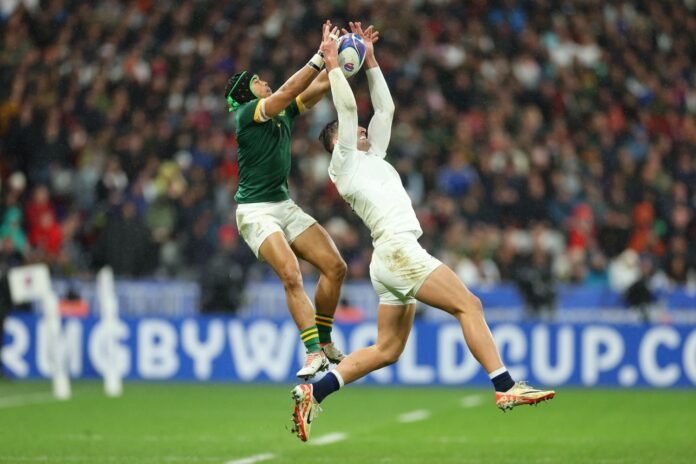
The Springboks believe the aerial contest has become one of rugby’s most exciting features, writes LINDIZ VAN ZILLA.
The Bok coaching staff this week came out strongly in support of contestable kicks in shaping a faster, more unpredictable – and ultimately more watchable – game.
While some critics have questioned the number of kicks in modern rugby, the Bok management insist the contestable kick – and the chaos that follows – is central to the sport’s evolution.
Assistant coach Felix Jones said that the aerial contest creates anticipation and opens up the game.
“The shape of the game with contestable kicks definitely makes it more open and unpredictable. That’s what people want to see. When a contestable kick goes up, nobody thinks the next phase is going to be boring. Everyone knows there’s going to be an athletic contest in the air and then a dynamic piece of play afterwards.”
According to Jones, the real spectacle often comes after the ball comes down.
“The unstructured nature of the game after the aerial contest creates opportunities for athletic and dynamic players,” he said. “Broken play almost becomes a separate contest. Skills and athleticism really come into play there.”
BROWN: Boks a lot more dangerous now
He added that while attack coaches enjoy the possibilities created by these situations, defensive systems are constantly being tested.
“Attack coaches love it, and defensive coaches have to apply their minds. Teams are adapting as well – some are kicking longer to avoid those contests, while others are finding new ways to compete for the breaking ball.”
Fellow assistant coach Mzwandile Stick, who has been central to the Boks’ aerial contest game, said the contestable kick has become a key tactical weapon across world rugby, with more teams embracing the strategy that South Africa have used so effectively.
“In the past, some teams preferred to kick long, but now more teams are leaning towards the contestable game,” Stick said. “If you look at France, for example, they’ve adapted and are very good in those transition moments.”
Stick believes those chaotic phases create some of rugby’s most memorable moments.
“When the ball comes down and things become unstructured, that’s when players with X factor get their opportunities,” he said. “That’s where a winger or a quick back can suddenly find himself one-on-one against a forward. Those are the moments supporters love to see.”
ALSO: Boks training to be tackle-smart
He also pointed out that the aerial contest places new demands on every player, not just the backline.
“When the ball lands, you often find tight forwards around that area as well,” Stick explained. “Those players must be able to make decisions quickly – whether to secure the ball, move it quickly or exploit space.”
Defence coach Jerry Flannery acknowledged that the rise in use of contestable kicks has made life more complicated for defensive systems.
“There are a lot of parts to it,” he said. “You’ve got the pressure you put on the quality of the opposition’s kick, then how you organise your players around the receiver, and how you position players to compete for the breaking ball.”
The Irishman believes these layers of contest have ultimately improved the spectacle.
“In the past, teams would try to create chaos with a quick tap or a quick throw,” he said. “Now every second or third kick can create that same situation where the game suddenly opens up.
“It’s definitely a challenge for defence, but it’s been good for the game.”
Photo: Cameron Spencer/Getty Images
The post Boks relish aerial warfare appeared first on SA Rugby magazine.