



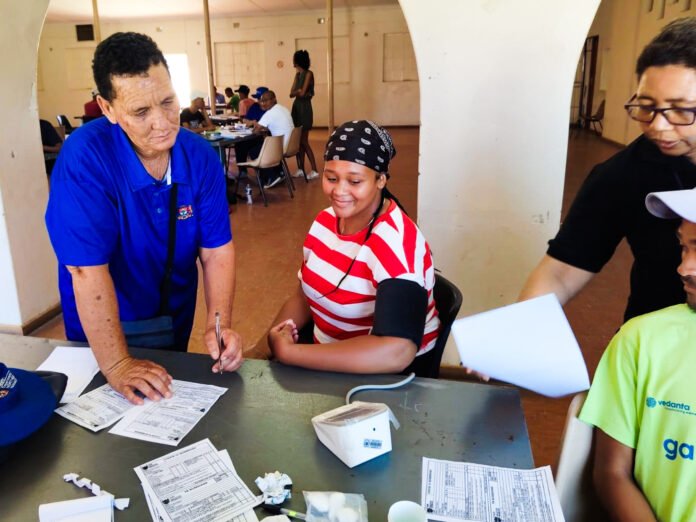

Some provinces have started implementing the January 2025 Labour Court ruling that community health workers (CHW) must be made permanent government employees. Until then, CHWs worked on contracts, earned stipends as low as R3000, and had no benefits, pension or job security.
In the Northern Cape, the process, marred by tension, has left many CHWs frustrated and uncertain. Some workers who have worked for more than 20 years say they have been excluded from permanent absorption.
By November, the province was estimated to have more than 1600 CHWs. But in January, the department announced that only 857 CHWs on its database who have matric would be permanently absorbed.
One of those still in limbo is *Sarah Dikobe, who has worked in Kimberly for nearly 10 years.
“In 2018, the department said they were absorbing us. We started getting R3500, with no pension and no benefits,” Dikobe tells Health-e News.
But the posts were not permanent. She and other CHWs remained on contract, sometimes signing one-year contracts, sometimes three-year ones.
“The department said they would absorb us according to the court ruling. But in here in the Northern Cape, they only take matrics. We didn’t know that,” Dikobe says.
Fed up with risk and low salaries, Community Health Workers to strike for job security
“I don’t have matric. And the contract I signed last year is ending in March. I don’t know what’s going to happen after that.”
Northern Cape Premier Dr Zamani Saul later announced an interim stipend increase of R1000 for CHWs waiting to be absorbed. The increase took effect at the start of the 2025/26 financial year and was meant to remain in place until permanent appointments were finalised for eligible workers. This raised Dikobe’s monthly pay to R6,000.
Adding to her distress are rumours that CHWs older than 50 would also not be absorbed. Dikobe is 48-years-old.
“I’m feeling very disappointed. I just look like a failure to my children. Sometimes I plan things and they don’t happen. Last year, they told us in March that we would be absorbed and that didn’t happen. I can’t stand their lies,” she says.
“It’s so stressful, especially month-end. The salary is not enough for me and my budget is out of hand.”
Dikobe supports three children and two grandchildren.
A ‘slap in the face’
Lerato Mpuisang (46), a mother of four in Kimberley, says she is deeply disappointed to have been overlooked after volunteering as a home-based caregiver since 2003.
“I decided to assist in my community after realising how HIV and AIDS, and TB were eating into my community. I then joined the Red Cross Association because, at least, they were providing gloves, detergents and some ointments that I could use and offer to the sick people,” says Mpuisang.
She says she played such an important role in the community that she was often called out at night.
“When I started, there was no mention of a stipend, and we were called home-based caregivers. And I was relieved to belong to an organisation that helped the community,” she recalls.
“I was bathing patients who were mostly bedridden, massaging and feeding them, sometimes cleaning their homes, ensuring that they take medication, and offering counselling.”
Mpuisang says she would walk to the clinic to collect medicine for patients who could not get there themselves or who were at risk of defaulting. Many of these are the same tasks performed by CHWs today.
“After volunteering for about three years, the stipend of R2000.00 was introduced,” she says.
She says the stipend increased over time, and that the health NGOs were later placed under an umbrella body called Legatus, which administered stipends. Workers also received training and attended workshops, including on TB.
“In 2018 we were shifted to the Department of Health and given Persal Numbers. To us, that was progress that we will eventually be absorbed permanently,” she says.
In that context, the department’s latest announcement, she says, “is truly a slap in my face”.
Other side of the coin
Not all CHWs experienced the process as a loss. More than 850 workers benefited from the absorption.
One of them is Dineo Malankane (41) from Kuruman, who started volunteering in 2005 and says the work exposed her to many hardships, including walking long distances in the scorching sun.
According to her employment letter, she is on a two-year probation period and will be made permanent if she completes probation successfully.
She says she was among the CHWs who took their frustrations to the streets almost every year to protest over delayed stipends, stipend increases and permanent absorption.
“I never thought that I would one day finally shout ‘Victory at last’ as I do now,” she says. “Finally going to get a 13th cheque and medical aid is a dream come true.”
Malankane, however, blames her colleagues for not heeding the call by the department over five years ago to get a matric.
“I, however, hope the department and the unions can keep their promises to absorb all my colleagues because we all fought for these benefits.”
Western Cape refuses to employ community health workers on a permanent basis
Another absorbed CHW from Kuruman says many of those who got posts are afraid to show their happiness because they work alongside colleagues who were left out.
He says the appointment has been bittersweet and that he no longer feels proud or excited to do the work he loves.
“We are afraid to speak up because we work together and understand their pain. We don’t even feel free to go out to the community out of shame of being labelled as the chosen ones,” he says.
“When we remain at the clinics, we also get negative remarks from them that we regard ourselves as nurses now.”
He says the department made a mistake by leaving others out and urges it to fulfil its promises.
Unions call the process unfair
The provincial secretary of the National Union of Public Service and Allied Workers (NEPSAW), Orateng Disipi, says it is unfair that some CHWs over the age of 50 have worked hard for years, only to be “spit out” for not having matric.
She says many overlooked CHWs without matric were trained through home-based care programmes and re-engineering courses, which enabled them to do the work and ease pressure on already stretched health facilities.
“Most of the CHWs in John Taolo Gaetsewe District are over the age of 50, have survived on a stipend for more than 20 years, have accumulated various training in their field of work, but could not benefit like others,” says Disipi.
“It is however sad that they did not receive certificates for most of those courses given by the Department of Health.” – Health-e News
*Additional reporting by Ina Skosana
*Not her real name