



02/04/2026 – 16:02 GMT+2
Whether in politics, the economy or energy security, relations between Azerbaijan and the EU have been developing dynamically, writes Dr. Matin Mammadli in an opinion piece for Euronews. Increased investment, technology transfer and visa facilitation would further strengthen these ties.
Relations between the Republic of Azerbaijan and the European Union (EU) have entered a phase of dynamic development in recent years and are increasingly acquiring a strategic character in political, economic, and energy security dimensions. In particular, changes in regional geopolitical realities, the restoration of Azerbaijan’s territorial integrity, and transformations in global energy markets have driven these relations into a new stage.

ADVERTISEMENT
ADVERTISEMENT
Azerbaijan-EU relations: pragmatic cooperation model
In official EU-level statements issued in March 2026, Azerbaijan is described as a “strategically important partner,” with emphasis placed on energy security, diversification of supply, and the relevance of dialogue in the context of rapidly evolving geopolitical dynamics in the Middle East . At the current stage, Azerbaijan-EU relations can be characterized as a pragmatic cooperation model based on mutual interests, with significant potential for further deepening.
It should be noted that the legal basis of Azerbaijan-EU relations is formed by the Partnership and Cooperation Agreement, which entered into force in 1999. In subsequent years, negotiations have been conducted on a new, more comprehensive agreement, and the scope of cooperation has expanded considerably. Furthermore, the “Partnership Priorities” document initialed in 2018 serves as a framework outlining sectoral cooperation based on shared values and principles of international law, including sovereignty and territorial integrity.
Energy cooperation between EU an Azerbaijan
Energy cooperation constitutes one of the main pillars of these relations. Azerbaijan is a reliable energy partner for the European Union. The Memorandum of Understanding on a Strategic Partnership in the Field of Energy, signed in 2022, envisages an increase in Azerbaijani gas supplies to the European market. In this context, the Southern Gas Corridor plays a crucial role in ensuring Europe’s energy security. The dynamics of energy cooperation are also reflected in quantitative indicators. In 2025, out of a total of 25 billion cubic meters of gas supplied by Azerbaijan, 13 billion cubic meters were exported to EU countries. This represents an increase of nearly 60% compared to 2021 .
At the same time, Azerbaijan is interested in expanding cooperation with the EU in areas such as transport, digitalization, trade, and institutional reforms. In particular, the Middle Corridor (Trans-Caspian International Transport Route) enhances Azerbaijan’s logistical importance for the EU. It should also be emphasized that the European Union is Azerbaijan’s main trading partner, accounting for approximately 50% of the country’s total trade turnover.
Strategic importance for the EU
Recent geopolitical developments have significantly increased Azerbaijan’s strategic importance for the EU. In particular, the Russia-Ukraine war has elevated energy security to a top priority for Europe, positioning Azerbaijan as an alternative energy source. Meanwhile, tensions and conflicts in the Middle East have affected global trade routes, strengthening Azerbaijan’s role as a transit country. Azerbaijan’s geostrategic location at the intersection of Europe and Asia, combined with its predictable and stable policy, makes it an indispensable partner for the EU. Looking ahead, there are broad opportunities to deepen cooperation between the parties, which promise substantial dividends for both sides.
Several priority areas can be identified: Energy and green transition – Azerbaijan’s renewable energy potential, particularly offshore wind energy in the Caspian Sea, offers significant prospects for cooperation and aligns with the EU’s green transition strategy. Transport and logistics – The development of an alternative and secure trade route between Europe and Asia through the Middle Corridor provides mutual benefits.
Several areas of cooperation
Digital economy and innovation – Cooperation can be expanded in digital transformation, startup ecosystem development, and technology transfer.
Education and humanitarian sphere – Increasing academic exchange programs and scientific cooperation can strengthen the social foundations of relations.
Security and stability – Ensuring peace and stability in the region, especially in the post-conflict period, remains of critical importance.
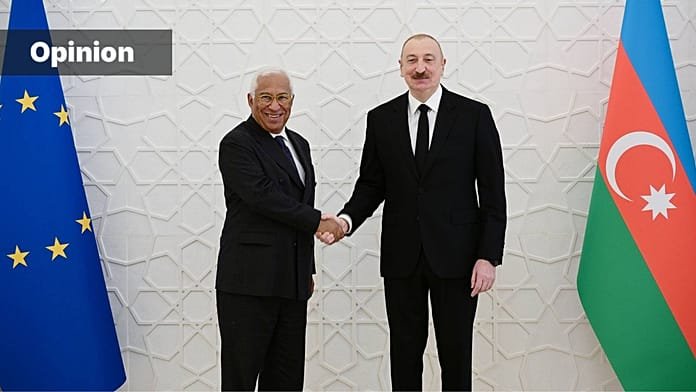
The visit of European Council President Antonio Costa to Azerbaijan on 11-12 March 2026 can be considered an important milestone in bilateral relations. During the visit, Costa held meetings with the President of the Republic of Azerbaijan, Ilham Aliyev, where discussions focused on political dialogue, energy cooperation, regional security, and economic ties. The joint statements of the leaders indicate a shared intention to deepen cooperation in economic, energy, transport, security, and other key areas.
EU’s “Global Gateway” initiative
Projects implemented within the framework of the EU’s “Global Gateway” initiative are also significant in terms of increasing investment flows into Azerbaijan’s economy, particularly in transport and logistics infrastructure and regional connectivity. Another notable aspect of Costa’s visit was its timing against the backdrop of increasing security risks in the region. Recent conflicts in the Middle East and broader geopolitical complexities have heightened the relevance of security issues.
During meetings in Baku, EU leadership expressed political support for Azerbaijan, taking into account the country’s security challenges. In this context, the visit can also be interpreted as a manifestation of EU political support. Azerbaijan is recognized as a state pursuing an independent and balanced foreign policy, aimed at ensuring sustainable peace, cooperation, and economic development in the region.
Stability in the South Caucasus
Stability in the South Caucasus aligns with the strategic interests of the European Union. Therefore, Azerbaijan-EU cooperation extends beyond bilateral relations and contributes to regional stability. During meetings in Baku, Costa emphasized the EU’s support for lasting peace and stability in the South Caucasus.
In conclusion, Azerbaijan is interested in deepening mutually beneficial cooperation with the EU and has several expectations: A more balanced approach in the post-conflict period – Azerbaijan expects the EU to adopt a more objective and balanced stance toward peace and reconstruction processes in the region. Participation in reconstruction – Greater EU involvement is expected in the reconstruction of territories liberated from occupation. The current limited engagement contrasts with the substantial financial assistance provided to Armenia after the Second Karabakh War, creating a certain imbalance. Expansion of economic and technological cooperation – Increasing investments and technology transfer are key priorities. Visa facilitation – Progress in simplifying visa procedures is important for enhancing people-to-people contacts.
The realization of these expectations would contribute to strengthening Azerbaijan-EU relations and fostering a long-term strategic partnership.
Dr. Matin Mammadli is a leading advisor at the Baku-based Center of Analysis of International Relations