


Australia’s post-Bondi crackdown accused of targeting pro-Palestinian voices
Fear for future of peaceful protest in Australia, while some say Jewish community being prioritised over others.
Save

 By Ali MCPublished On 27 Mar 202627 Mar 2026
Melbourne – Human rights groups have slammed the Australian government’s new “hate speech” laws, saying they will have a “chilling effect” on those who support the Palestinian cause.
Most recently, two activists were arrested and charged for chanting the slogan “From the river to the sea”, a phrase that, along with “Globalise the Intifada”, is now illegal in Australia’s northern state of Queensland.
Recommended Stories
list of 4 itemsend of list
Anyone arrested under the new law is faced with a maximum penalty of two years’ imprisonment.
Rushed through the New South Wales federal parliament after an attack on a Jewish celebration in Sydney’s Bondi Beach in December, which killed 15 people, the new laws operate at both federal and state jurisdictions and specifically target speech considered anti-Semitic.
Arif Hussein, senior lawyer at the Human Rights Law Centre in the New South Wales capital, Sydney, told Al Jazeera the legislation could be used to suppress legitimate criticism of Israel’s genocide in the Gaza Strip.
“There are serious concerns that the new laws could have a chilling effect on legitimate activism and protest and unfairly impact peaceful protest and speech regarding Israel’s actions in Palestine,” Hussein said.
“While there is no place for anti-Semitism or racism in Australia, everyone has the right to criticise state conduct and hold public officials to account,” he said.
The Bondi shooting was a rare incident of mass violence in Australia and prompted a royal commission of inquiry as well as the introduction of new legislation on hate speech and extremism, and a strengthening of gun ownership laws.
The Combatting Antisemitism, Hate and Extremism Act was rushed through the New South Wales federal parliament in January and includes higher penalties for existing hate crime offences, expanded offences for displaying or distributing prohibited symbols considered hateful, and an easier process to deport or cancel the visas of individuals associated with proscribed groups.
Advertisement
Hussein said the laws were ambiguous in defining what constitutes a hate group and could be used against legitimate human rights groups, including those focused on Palestine.
“The laws introduce broad and poorly defined criminal powers directed at ‘hate groups’ without the opportunity for impacted groups to be heard before being listed,” he said.
“This uncertainty has been exacerbated by inconsistent explanations from the government about whether the legislation could apply to criticism of a foreign government’s conduct, increasing fears that advocacy for Palestinian rights may be improperly scrutinised.”
‘Stomping me, grabbing me and choking me’
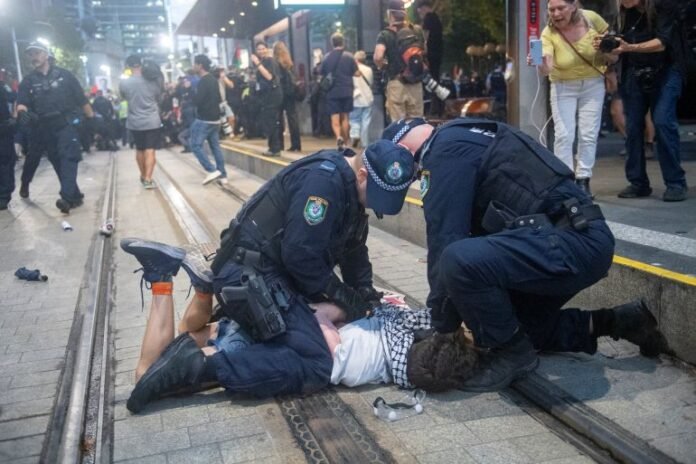
Police powers across Australia have also been strengthened to crack down on pro-Palestine protests, such as the rallies in Sydney protesting the visit in February of Israeli President Isaac Herzog.
Herzog was in Australia on an official visit to meet with the government and Jewish groups after the Bondi attack, but his presence in the country prompted thousands of protesters to gather in the city to condemn Israel’s ongoing genocide in Gaza.
The peaceful protests were met with extreme police violence, with video footage from the rally showing demonstrators being repeatedly “kidney punched” and pepper-sprayed by police, who charged at crowds and violently dragged away praying Muslim men.
Ali Al-lami, a 23-year-old student who was arrested at the protest, alleged that police racially abused and assaulted him.
“Right after stomping me, grabbing me and choking me, and putting cuffs onto my hands, they landed punches onto my head and started bashing me,” Al-lami told Al Jazeera.
Al-lami said the new laws introduced to combat so-called hate speech were a continuation of repression against activism – from climate change to Palestine – that began long before the Bondi attack.
The New South Wales government wants to “break and crack down onto the Palestinian movement forever”, he said.
According to the Human Rights Law Centre’s recent report, Protest in Peril, the right to peaceful demonstration has been under attack for two decades, with authorities in New South Wales having introduced the most anti-protest laws of any federal government.
The State of Victoria, in the nation’s southeast, has also seen an increase in police powers targeting Muslim communities and pro-Palestinian protests.
Police in the state are now able to declare “designated areas” where they have increased powers of dealing with members of the public, including the power to stop and search at will.
Advertisement
They can also direct a person to leave a location if they refuse to remove a face covering, which police believe is being used to either conceal a face or as a means of protection against crowd control measures, such as police pepper spray.
Activists report that pepper spray is now routinely used against protesters in Australia, along with non-lethal weapons such as “flash-bang” grenades and hard-foam baton round bullets.
A Ramadan night market in the Dandenong suburb of the state’s capital, Melbourne, was recently declared a designated “stop and search” area, which “sends a deeply troubling message”, said Nour Salman of the Australia Palestine Advocacy Network.
“Legitimate criticism of Israel and advocacy for Palestinian rights is not dangerous or unlawful,” Salman said.
“Palestinians and their supporters should not have to worry that speaking out against genocide could be treated as a crime.
“For Muslim communities already facing rising hostility, it reinforces the idea that even spaces of faith, culture and celebration are viewed through a lens of suspicion. That approach does not build trust. It entrenches fear and normalises the policing of Muslim and Palestinian identity,” she added.
‘Made the decision to protect just one religion’
The New South Wales federal hate speech laws were part of a suite of recommendations made by Jillian Segal, the government-appointed special envoy to combat anti-Semitism, who argued that “since 7 October 2023, anti-Semitism has risen to deeply troubling levels in Australia.
“Ancient myths and misinformation have re-emerged in new forms to justify violence and threats against the Australian Jewish community,” Segal, a South African-born lawyer, wrote in her report on plans to tackle anti-Semitism.
Along with the Bondi attack, there have also been attacks on synagogues and Jewish businesses across the country, while Neo-Nazism is on the rise.
Far-right and fascist groups, such as the National Socialist Network, have organised public anti-immigration marches, one of which saw an attack on an Indigenous sacred site in Melbourne, Australia’s second-largest city.
The attack involved about 40 men dressed in black who charged an encampment at the Aboriginal site, injuring women and damaging property.
Indigenous leader Robbie Thorpe, who oversees Camp Sovereignty, said such violence against Indigenous people needs to be taken as seriously by the government as its campaign against anti-Semitism.
“The [attack on Camp Sovereignty] was an act of terrorism,” Thorpe said.
“We warned the city council about the rise of the threat of violence by these guys. We warned them before that happened,” he said.
In January, a man was charged with throwing an explosive into a group of pro-Indigenous demonstrators in the Western Australian city of Perth.
Fortunately, the device did not explode, but Thorpe questions why such incidents of violence against Indigenous Australians are not taken as seriously as anti-Semitism.
“It’s offended a lot of Aboriginal people that straight away they can get an inquiry or a royal commission into anti-Semitism,” said Thorpe. “We’ve been talking about the issue of racism in this country the entire time.”
Advertisement
Indigenous Australians, since British colonisation, have been victimised by massacres, forced child removals and land dispossession, underpinned by racially-based government legislation.
A 2023 referendum to include an Indigenous voice to parliament and address ongoing injustices and inequalities experienced by First Nation people was soundly rejected, while the period was marked by a spike in racism towards Indigenous peoples.
Prime Minister Anthony Albanese has defended the new laws targeting hate crimes, saying “the terrorists at Bondi Beach had hatred in their minds but guns in their hands. This law will deal with both, and we need to deal with both.
“We want to ensure that Australia remains a society where everyone has the right to be proud of who they are,” he said.
However, Greens party spokesperson Senator David Shoebridge said the laws are primarily designed to prioritise the protection of the Jewish community in Australia.
“We know that hate touches all marginalised people. The same hateful ideology that led to the appalling Bondi shooting could also be weaponised against women, members of the Muslim community or LGBTQ+ Australians,” he told Al Jazeera.
“This law was deliberately designed to not protect these vulnerable parts of our community, and that seriously undermines its legitimacy and utility,” he said.
“Unfortunately, the Albanese Labor government and the Liberals made the decision to protect just one religion.”