


19/03/2026 – 9:38 GMT+1
A pro-Russian online campaign is casting the Estonian city of Narva as a “people’s republic”, spreading propaganda and at times calling for violence and sabotage.
A flag, a coat of arms, freshly drawn borders – and rhetoric that echoes the playbook of the so-called “people’s republics” in eastern Ukraine and Russian-occupied Crimea.

ADVERTISEMENT
ADVERTISEMENT
On social media, Estonia’s third-largest city, Narva, is now being cast as a so-called “People’s Republic of Narva”.
Research by the Estonian anti-propaganda platform Propastop suggests the campaign is built around an alleged separatist narrative, aimed at peeling away the country’s Russian-speaking north-east, right along the Russian border.
Could Germany’s Battletank Brigade be dragged in?
If tensions in Estonia were to escalate militarily, Germany’s brigade stationed in Lithuania could find itself drawn into the conflict.
The Battletank Brigade 45 is based in Pabradė, near Lithuania’s border with Belarus – roughly 400 kilometres from Narva – and is intended as a deterrent.
While formally deployed in Lithuania, its remit goes beyond national borders: it forms part of NATO’s wider effort to secure the alliance’s eastern flank, with the Baltic states on the front line.
In the event of a conflict, “the German presence in Lithuania would, of course, be called upon immediately as reinforcement,” said military expert Dr Carlo Masala, a professor at the University of the Bundeswehr in Munich, in an interview with Euronews.
At the same time, Masala notes that Berlin might opt to hold the brigade in place, wary of the risk of further escalation on Lithuanian territory.
‘Are you afraid?’
The most prominent Telegram channel so far, “Narva Republic,” was set up on 14 July last year and now has more than 700 subscribers. It has only been actively posting, however, since 18 February 2026.
Its content mixes calls for armed resistance and sabotage with a familiar narrative: that of a Russian-speaking minority subject to alleged discrimination, alongside claims designed to stoke fears of an Estonian attack on Russia.
One post, dated 19 February, cites Estonian Foreign Minister Margus Tsahkna as saying: “The Estonian army will cross the border and shift the war to Russian territory if the Russian army invades Estonia,” before ending with the question: “Are you afraid?”
In context, however, the quote is misleading. In an interview with The Telegraph newspaper, Tsahkna said that, in the event of a Russian attack on the Baltic states, they would take the war to Russian territory and strike in the hinterland, not that Estonia would launch any kind of pre-emptive invasion.
Another Telegram post claims the separatists are “in favour of autonomy,” warning that if this were denied it could escalate into a “full-fledged armed conflict” and the creation of an independent state within Ida-Viru, the eastern region bordering Russia.
Memes designed to unsettle
Military expert Carlo Masala does not see an immediate threat, but cautions against dismissing the campaign outright. In his view, it is “part of a psychological warfare campaign.”
Russia, he argued, is unlikely to open a second front alongside its war in Ukraine and there are no signs of an imminent attack on Narva.
Even so, “it should not be taken lightly.”
What stands out is the blend of memes, dark humour and propaganda, content, Masala said, designed to make people “nervous” and even “hysterical.”
Among the examples are mock “daily routines” of a so-called “Narva militia,” featuring the staged capture of nearby Estonian towns such as Sillamäe and Kohtla-Järve.
One post lays it out like a timetable: wake-up at 6am, breakfast at 8am, the “storming of Narva” at 9am, followed by lunch and by mid-afternoon, the “capture” of Sillamäe and Kohtla-Järve.
The day supposedly ends with concerts by pro-Russian rapper Akim Apatschew and the controversial band Burzum, which has been criticised for its ideological links to National Socialism, before a final “salute” at 10pm.
Alongside this, the channel circulates maps outlining a supposed “People’s Republic,” complete with newly drawn borders, as well as green, black and white flags.
If the situation were to escalate, though, Masala added, NATO’s regional defence plans would come into play, provided member states agree.
“Initially, the Enhanced Forward Presence in Estonia would take the lead,” he explained. At the same time, he added, “the German presence in Lithuania would, of course, be called upon immediately as reinforcement.” Still, he stressed that such contingency plans are classified “for good reason,” meaning how Estonia and NATO would respond in detail remains uncertain.
The so-called ‘People’s Republic of Narva’
Narva sits directly on Estonia’s border with Russia and, with around 50,000 residents, is the country’s third-largest city. More than 90% of its population is Russian-speaking, many of them Estonian citizens.
Much of today’s population traces its roots to the post-war period, when families were resettled to the region after the original inhabitants were largely displaced during the Soviet advance in 1944.
When Euronews reported from Estonia in 2022, residents said they did not feel discriminated against because of their Russian language. Yet for years, Kremlin-aligned television has sought to frame the Russian-speaking minority as victims.
On Russian state channels, including talk shows such as 60 Minutes on Rossiya 1, narratives about “fabricated criminal cases against Russian-speaking compatriots” in the Baltic states are a recurring theme.
Estonian intelligence warns of ‘coordinated campaign’
Estonia’s domestic intelligence service believes the activity may be part of a coordinated information campaign.
“Such tactics have been used before, both in Estonia and elsewhere,” an ISS spokesperson told the Estonian news outlet Delfi.
“It is a simple and low-cost way to provoke and intimidate society.”
According to the agency, the aim is to sow confusion and weaken social cohesion, an assessment that aligns with that of military expert Carlo Masala.
In his 2025 book If Russia Wins, Narva serves as a thought experiment. How far would NATO go if Estonia were attacked?
“Do we risk a full-scale conflict against potentially 1.5 million Russian soldiers for the liberation of a city of 50,000 inhabitants – one that would always be on the brink of nuclear escalation?” Masala asked during an appearance on the German programme ntv Salon in 2025.
From ‘little green men’ to the so-called ‘People’s Republic’
The proclamation of a so-called “people’s republic” is a familiar ploy. In 2014, pro-Russian separatists, backed by Moscow, declared the self-styled “people’s republics” of Donetsk and Luhansk in Ukraine’s Donbas region.
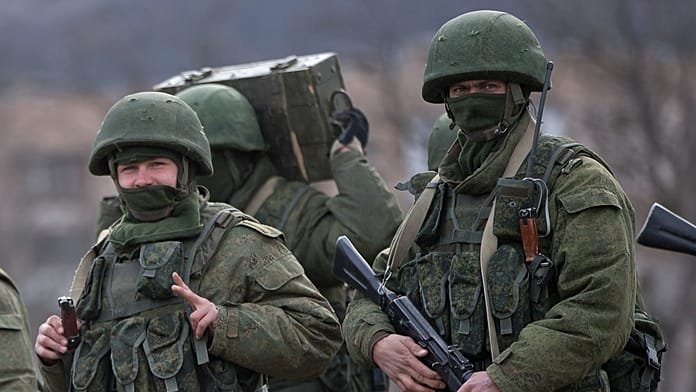
During the occupation of Crimea the same year, Russia deployed the so-called “little green men,” soldiers without insignia, to establish control while maintaining plausible deniability.
Years later, the Kremlin also used the alleged need to “protect” Russian-speaking populations to justify its full-scale invasion of Ukraine. Yet there is no evidence that ethnic Russians faced systematic persecution by Ukrainian authorities, let alone any threat of extermination based on nationality, ethnicity or cultural identity, a finding supported by reports from the Council of Europe, the UN High Commissioner for Human Rights and the OSCE.
“The emergence of a ‘People’s Republic of Narva’ narrative lays the groundwork for later claims of oppression and calls for ‘protection’ from Moscow,” political scientist Nico Lange wrote on X, warning that such messaging could be amplified domestically as well.
According to him, “this propaganda must be exposed, networks of influence dismantled, and Russian intelligence operatives expelled.”