


11:16
In Moscow, a scaled-down Victory Day parade was held under tight security, without military hardware, amid fears of possible Ukrainian drone attacks. The Russian president denounced NATO in his speech.
Enhanced security measures have been taken in Moscow ahead of President Vladimir Putin’s speech at the Red Square parade marking the victory over Nazi Germany in World War II.

ADVERTISEMENT
ADVERTISEMENT
Meanwhile, a three-day ceasefire brokered by the United States the previous day eased fears of possible Ukrainian strikes on the Russian capital during the celebrations.
Speaking in front of hundreds of military personnel and flanked by a few world leaders, the Russian president said he was fighting a “just” war as he identified Ukraine an “aggressive force” that is being “armed and supported by the whole bloc of NATO”.
Putin, in power for more than a quarter of a century, uses Victory Day, Russia’s most important secular holiday, to showcase the country’s military might and rally support for a military invasion of Ukraine starting in 2022. However, this year, for the first time in nearly two decades, the parade is being held without tanks, missiles and other heavy weaponry, except for the traditional flyover of combat aircraft.
Russian officials attributed the sudden change in format to the “current operational situation” and cited the threat of Ukrainian attacks. Kremlin spokesman Dmitry Peskov said “additional security measures” had been taken.
Previous ceasefire agreements have not held up
Russia declared a unilateral ceasefire for Friday and Saturday, while Ukrainian President Volodymyr Zelensky imposed a truce from 6 May, but neither agreement was honoured as sides exchanged mutual accusations of continued attacks.
On Friday, US President Donald Trump announced that Russia and Ukraine had accepted his request for a ceasefire from Saturday to Monday and agreed to exchange prisoners, saying a pause in fighting could be the “beginning of the end” of the war.
Zelensky, who said earlier this week that Russian authorities “fear drones could fly over Red Square” on 9 May, followed up on Trump’s statement by issuing an executive order “allowing” Russia to hold Victory Day celebrations on Saturday, declaring Red Square temporarily closed to Ukrainian strikes.
Peskov, the Kremlin spokesman, called Zelensky’s decree a “silly joke” as he told reporters, “We don’t need anyone’s permission to be proud of Victory Day.”
Russian authorities have warned that if Ukraine tries to disrupt Saturday’s celebrations, Russia will launch a “massive missile strike on the centre of Kyiv”.
Russia’s defence ministry urged civilians and staff of foreign diplomatic missions to “immediately leave the city”. The EU said its diplomats would not leave the Ukrainian capital despite Russian threats.
Putin is using Victory Day celebrations to bolster national pride and emphasise Russia’s position as a world power. The Soviet Union lost 27 million people between 1941 and 1945 in the Second World War.
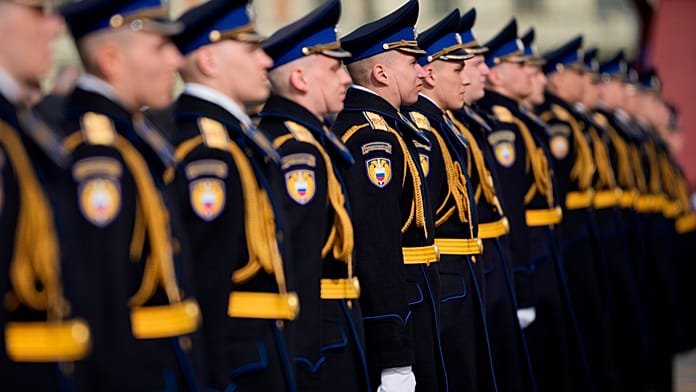
Addressing the parade participants, the Russian president recalled the huge contribution of the Soviet people to the victory over fascism and said his soldiers are now fighting in Ukraine against an “aggressive force” backed by NATO.
Putin expressed confidence in victory in Ukraine
“Victory has always been and will always be ours,” Putin said as columns of troops lined Red Square. “The key to success is our moral strength, courage and valour, our unity and ability to withstand anything and overcome any challenge.”
Those present in Red Square were then shown a propaganda video sequence designed to emphasise the power of the Russian army and its “achievements” in the war against Ukraine.
Russian military units paraded through Moscow’s Red Square, accompanied by an official broadcast detailing the armed forces’ various accomplishments.
Among those marching were North Korean soldiers who had been sent to help the Russian army in the war against Ukraine. They had, as the announcer’s speech claimed, made a great contribution “to the defeat of neo-Nazi invaders in the Kursk region.”
The parade was over in 45 minutes
On Saturday, as troops prepared to march through Red Square, authorities imposed restrictions on access to mobile internet and text messaging services in the Russian capital, citing public safety.
The government has been methodically tightening internet censorship and imposing ever-tighter controls on online activity, prompting discontent and rare public displays of discontent.
Malaysia’s King Sultan Ibrahim Iskandar, Lao President Thongloun Sisoulith, Kazakh President Kassym-Jomart Tokayev, Uzbek President Shavkat Mirziyoyev. Belarusian President Alexander Lukashenko and Slovak Prime Minister Robert Fitzo travelled to the Russian capital for the celebrations.