




When Boitshwarelo Moholo from Atamelang, Dellerayville in the North West, first learned that her son Kamogelo, who was three years old at the time, had autism, her world shifted instantly.
Moholo says her son Kamogelo had always been hyperactive. By the time he was two years old, he was singing and could say a few words. But when he turned three, the talking stopped.
“He kept on singing, he could not do one thing at a time, he would colour in a book, then leave it and take a car, then take a phone, while there he would move on to a tv remote,” she says. “His concentration span was not normal at all.”

Kamogelo, who is now 10, is non-verbal and lives with multiple diagnoses. In addition to autism, he was diagnosed with attention-deficit/hyperactivity disorder (ADHD), as well as a sensory disorder.
“At that very moment, I felt like the world could open up and swallow me,” she recalls. “I couldn’t believe what the doctor was telling me. I had only heard the word ‘autism’ a few times on the radio, but I wasn’t interested in knowing more. I cried in that consulting room. I felt empty, helpless, and emotionally broken.”
Autism is a spectrum of complex neurodevelopmental disabilities, which means that the brain of a person with autism might develop differently. They communicate, interact, and perceive the world differently from the average person.
“Everything was too much, the doctor told me about medication, occupational, speech and hearing therapy, and a psychologist. I wondered how I would be an amazing, loving mother.’’
A diagnosis, and then what?
One of Moholo’s biggest challenges was finding a suitable school. Kamogelo finished pre-school when he was five. But it would take more than four years for his mother to enrol him on a school for children with special needs.
“We couldn’t find a school that caters specifically to his condition,” Moholo explains. “The fact that he is non-verbal makes it even harder to let him go because he can’t tell me when something wrong has happened to him in my absence.”
For many parents, education is one of the most difficult hurdles. Specialised schools are few, often far away, and have limited intakes.
Dikeledi Phage spent around three years trying to find a school for her son
“I am based in Mahikeng in the North West province, where access to autism-specific schools is extremely limited. Securing placement for my son was not easy,” she recalls. “I went through multiple applications, long waiting lists, and numerous assessments at different schools.”
Finally, in 2018, after persistent efforts, he was accepted into a boarding school in Potchefstroom – more than 200 km from home.
“Initially, my son struggled to adjust to the boarding environment. As a parent, it was incredibly difficult to be separated from him. I had always been his primary caregiver and understood his needs best,” Phage tells Health-e News. “Being over two hours away added to my anxiety. There were times of deep emotional strain and sleepless nights.”
At times, her son, now 15, would refuse to go back to school after being home for the holidays. This raised red flags for Phage about how he was being treated at the facility. But instead of pulling him out of school, she decided to get more involved.
“I offered my support and became more involved in understanding how the school operates, and whether staff members were adequately trained to support children with autism and other developmental conditions,” she says.
“Through this involvement, I discovered a significant gap in capacity and training. The school is designated as a special needs institution. Yet many caregivers and support staff, particularly in the hostel, didn’t understand the children’s specific conditions.”
She says the support staff’s role was limited to basic physical care, such as bathing and dressing. But they were ill-equipped to deal with emotional and behavioural needs.
The North West Department of Education says a multi-disciplinary team of therapists provide therapeutic services to learners with special needs, including those on the autism spectrum.
Spokesperson Vuyo Mantshule says teachers are trained in different programmes to ensure they can identify and support learners with barriers.
“Since the year 2022 to date, at least 50 teachers from all 32 special schools across the province, and 10 officials have been trained on the autism spectrum,” says Mantshule.
“This allows teachers in special schools to be able to support learners directly and officials to support teachers in public schools who deal with mild to moderate barriers.”
Stigma and misunderstanding
Beyond the struggle for services, many parents face stigma within their own communities.
“People say it’s ‘English things’ or that your child is spoiled,” Phage says. “These judgments are painful. They come from a lack of understanding.”
There are many misconceptions about autism, including beliefs that autism is caused by poor parenting or cultural influences. Some people believe that autism is caused by witchcraft or that children will outgrow it. Many families of children with autism end up isolated and left with very little to no support.
For Lesego Lorekang, a mother from Lokaleng village in Mahikeng, that isolation became a turning point.
After her own child’s diagnosis, she found herself navigating long waiting periods for assessments, limited information at clinics, and a lack of local support groups.
“That personal journey opened my eyes to how isolating it can be,” she says. “Many families are going through the same challenges, but silently.”
When parents become advocates
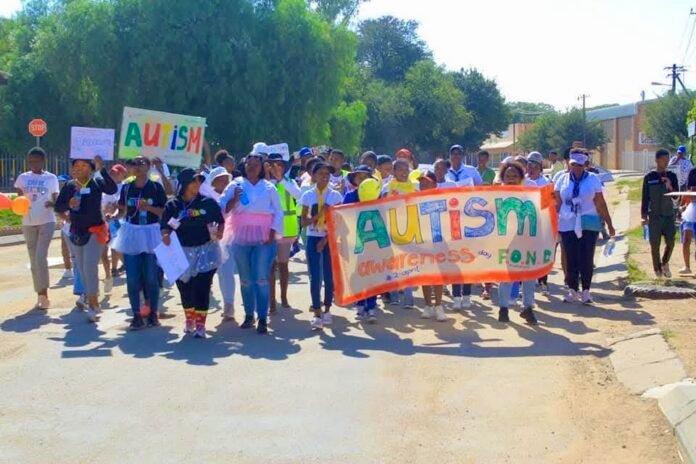
To ensure that other parents don’t experience what she has gone through, Lorekang started a foundation for families of people living with neurodevelopmental disorders (FOND) in 2023. The aim was to support caregivers, raise awareness and advocate for inclusion.
“I realised many parents are asking the same question: ‘What do I do now?’” she says.
Through training programmes, workshops and community outreach, the organisation provides practical support to families who might otherwise be left without guidance.
Lorekang, a trained caregiver and skills facilitator, says access to information can be life-changing.
“The programme gave me knowledge and understanding. I began to see my child not through fear, but through clarity,” she says.
Her work has taken her into schools, clinics, churches and taxi ranks, spaces where, she says, stigma is often deeply rooted.
“Changing attitudes requires patience, trust and consistent education.”
The hidden toll on parents
For many caregivers, the burden is not only practical but deeply emotional.
Parents describe constant vigilance, managing meltdowns, navigating therapies and advocating for their children, often without support.
“Some parents don’t even have someone to look after their child for an hour,” says a regional autism support worker. “They are exhausted and overwhelmed.”
Dineo Mosiane, a regional development officer for Autism South Africa, says parents of children with autism often face pressure, burnout, and mental health strain due to a lack of support despite having people around them.

“In my work, I get calls from parents from all districts in the province, from parents at different socio-economic and literacy levels,” she says. “Some have no one helping them, even just to look after their child for one hour. They must be constantly hovering over the child, making sure they are regulating during those meltdowns and managing their day-to-day activities.”
Healthcare professionals say the strain is significant.
“Parents of children with autism face emotional and financial challenges from navigating diagnostic processes to accessing appropriate interventions and support services,” says Dr Tumelo Leeuw, a paediatrician in Mahikeng with a special interest in autism.
“The journey can be emotionally and financially taxing, as families grapple with understanding their child’s unique needs and advocating for their well-being within educational and healthcare systems.”
Gaps in the system
Gomotsegang Mabyane, an occupational therapist at Bokgoni Occupational Therapists in Mahikeng, says policies are more inclusive.
“But there remains a significant gap between policy and practice. Many teachers are not sufficiently equipped with practical skills and ongoing support required to effectively accommodate learners with autism.”
Mabyane stresses that autism is not something to be fixed but rather a different way of experiencing and interacting with the world.
“Many of the challenges faced by autistic individuals arise not from the condition itself, but from environments that are not designed with their needs in mind,” she says. “Through understanding, respect for structure and routine, supportive communication, and internal environment design, autistic individuals can participate meaningfully in their communities.” – Health-e News