



wildlife
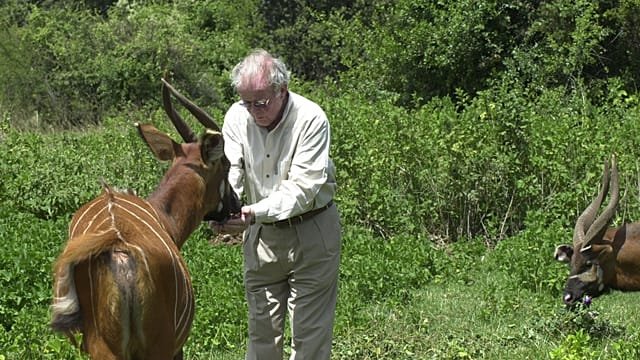
With a deep reddish brown coat marked by narrow vertical white stripes and long spiralled horns, the mountain bongo is the largest forest antelope in Africa and is found only in the montane forests of central Kenya.
It’s a subspecies of bongo adapted to high altitude environments, relying on dense forest cover for protection and feeding primarily on leaves, bark and shrubs.
But decades of habitat loss, illegal hunting and human expansion into forest areas have driven the species to critically low numbers.
Nick Davis, Mammals General Manager at Chester Zoo, says the scale of the decline is severe:
“Mountain Bungo are only found in Kenya. They’re critically endangered and one of Africa’s rarest large mammals. So in the wild they estimate, it’s hard to know for sure, but certainly less than a hundred individuals left in the wild.”
Accurate counts are difficult because the animals are elusive, moving through thick vegetation and often active at night, which has historically limited direct observation.
Despite that, conservationists say the trend has been clear, with wild populations fragmented and declining.
The species is now considered critically endangered and conservation programmes are shifting focus to active recovery of populations.
As part of that effort, four male mountain bongos bred in European zoos are being prepared for transfer to Kenya.
They will be sent to the Mount Kenya Wildlife Conservancy, where they will join an existing managed population and be used for breeding.
The aim is to strengthen genetic diversity, increase population numbers and produce offspring that could eventually be reintroduced into protected forest habitats in the wild.
“They’re beautiful looking animals. They’ve got long, curled horns, the chestnut colour, with a light stripe pattern that’s unique to each animal on either side. They’re really stunning animals and definitely worth protecting,” says Davis.
“These four bulls that have been selected, they were born and raised in European zoos, but because we’ve got a good programme, we know the genetics of every single animal in the population in zoos. So we’re able to select the ones with the best genetics that suit the animals over at Mount Kenya Wildlife Conservancy. So these four bull will be breeding with the cows that are currently over at Mount Kenya Wildlife Conservancy and their offspring then will help the population and potentially be part of the rewilding programme,” he adds.
The hope is that detailed genetic records across the breeding programme will enable conservationists to avoid inbreeding and select individuals that will strengthen genetic diversity in the Kenyan population.
Before relocation, the animals undergo a series of veterinary checks, disease screening and quarantine procedures to meet international wildlife transfer standards.
They are then transported to the Mount Kenya Wildlife Conservancy, where they are introduced gradually into a managed breeding population.
That conservancy has already reached around 100 individuals under human care, with a national target to build a population of at least 750 animals as a foundation for future reintroductions into protected forest habitat.
Alongside breeding, conservationists are also working to better understand how bongos behave in the wild, using new monitoring technologies.
Artificial intelligence powered camera systems have been developed to detect and identify bongos automatically, distinguishing them from other antelope species and tracking individuals using their stripe patterns.
Davis says the technology is helping overcome challenges in conserving the species:
“The forest antelope, they live in the thick bushes and vegetation, and they’re really difficult to find, often nocturnal. So the use of these AI cameras, they actually recognise mountain bongo from other antelope, but also the learning cameras so they can potentially also identify individual animals. They have unique strike patterns on their side so with this they can actually really help us get more information about their behaviours, their ranges and learn more so when we do eventually rewild then we can make sure that we know exactly the habitat and information they need.”
The data collected is used to map movement patterns, habitat use and social behaviour, all of which are critical for planning successful reintroductions.
By linking controlled breeding, advanced monitoring and habitat protection, the programme aims to rebuild a self sustaining population in Kenya’s forests and re-establish the mountain bongo as a viable species in the wild.
You may also like
Most read