


Caster Semenya
Semenya criticizes IOC chief Coventry after transgender athletes barred
00:20 – 01:02 – SOUNDBITE (English) Caster Semenya, two-time women’s 800m Olympic champion:
“For me personally, I’ll say the voice is not heard because you taking it as a tick box, you ticking a box so you can go clarify or say yes we’ve consulted. For me it’s you ticking the box. Personally for her as a leader (IOC President – Kirsty Coventry) she’s an African I’m sure she understand how you know we as Africans we coming from as a global South you know and you cannot control you know genetics. For me personally for her being a woman coming from Africa knowing how we know African women or women in the global South are affected by that.”
01:16 – 01:51 – SOUNDBITE (English) Caster Semenya, two-time women’s 800m Olympic champion:
“Of course it causes harm you know bodily I’ll say and for her (IOC President – Kirsty Coventry) obviously if you say the science because we talk about science here. If the science is clear show us who decided and don’t dress that as a lie because it’s a lie and we know because we’ve seen it so if we were to answer or confront Kristy that’s how we gonna respond and we’ll respond strong as we are because it affects women.”
STORYLINE:
A South African Olympic champion spoke out Sunday about the new Olympic ban of transgender women athletes.
Transgender women athletes are now excluded from women’s events at the Olympics after the IOC agreed to a new eligibility policy on Thursday which aligns with U.S. President Donald Trump’s executive order on sports ahead of the 2028 Los Angeles Games.
After an executive board meeting, the IOC published a 10-page policy document that also restricts female athletes such as two-time Olympic champion runner Caster Semenya with medical conditions known as differences in sex development, or DSD.
Semenya, during a press conference after a race in Cape Town, called out IOC President Kirsty Coventry for making the ruling, saying “she’s an African I’m sure she understand how we as Africans, we coming from the global South, you cannot control genetics.”
Before the 2024 Paris Olympics, three top-tier sports — track and field, swimming and cycling — excluded transgender women who had been through male puberty.
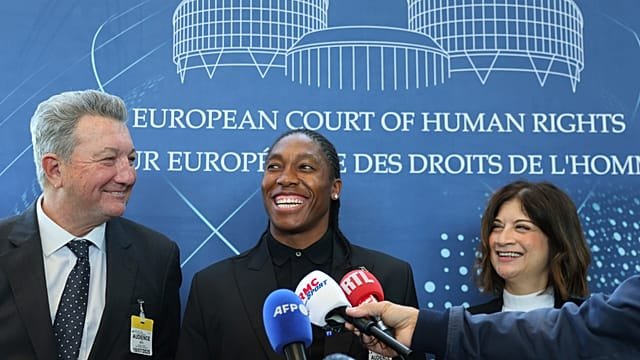
Semenya, who was assigned female at birth in South Africa and has testosterone levels higher than the typical female range, won a European Court of Human Rights judgment in her years-long legal challenge to track and field’s rules which did not overturn them.
“We know that this topic is sensitive,” IOC President Kirsty Coventry said in an online news conference to explain the policy.
Coventry and the IOC have wanted a clear policy instead of continuing to advise sports’ governing bodies who previously have drafted their own rules.
“At the Olympic Games, even the smallest margins can be the difference between victory and defeat,” Coventry, a two-time Olympic gold medalist in swimming, said in a statement. “So, it is absolutely clear that it would not be fair for biological males to compete in the female category.”
She set up a review of “protecting the female category” as one of her first big decisions last June as the first woman to lead the Olympic body in its 132-year history.
“If the science is clear show us who decided and don’t dress that as a lie because it’s a lie,” Semenya said criticizing the judgement.
You may also like
Most read