


28/03/2026 – 13:39 GMT+1
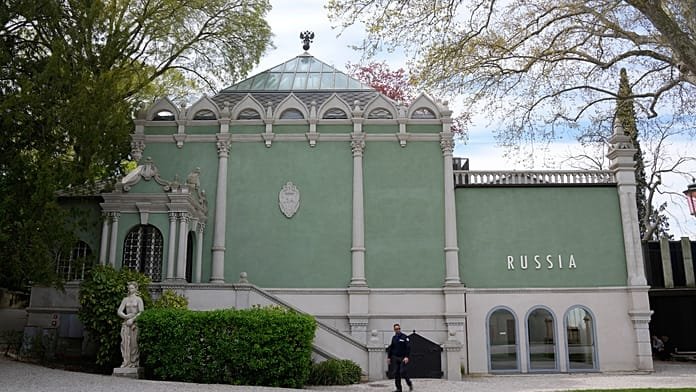
MEPs have urged European Commission leaders to prevent Russia from participating in the Venice Biennale. The move has been backed by Ukraine’s foreign policy chief who says “Russia rejects all proposals to end the war and rejects the dialogue that the organizers of the exhibition claim.”
“Trust in the European Union will be undermined” if it does not prevent Russia’s participation inthe 61st Venice Biennale, and the EU’s top leadership should take “urgent and decisive steps” in this regard.

ADVERTISEMENT
ADVERTISEMENT
These were the words MEPs addressed to the head of the European Commission Ursula von der Leyen, the Foreign Ministry of the Cypriot Presidency of the Council of the EU, the European Commission’s foreign policy chief Kaja Kallas and a number of other high-ranking officials in a letter that has come into the possession of Euronews.
In it, the MEPs condemned the decision by the biennale’s organisers to welcome Russia back in the fold while “Ukrainian cities are bombed, civilians are killed and Ukrainian cultural heritage is systematically destroyed”.
“Under no circumstances should Russia – a state under extensive European Union sanctions – be allowed to participate in an event funded by European taxpayers,” the text reads.
According to the signatories, the opening of the Russian pavilion would “raise the prestige and give legitimacy” to a country that “has lost it through its actions (in Ukraine)”.
In comments to Euronews, the Ukrainian Foreign Ministry speaker Georgiy Tykhiy thanked the MEPs for their moral clarity and principled stance.
“We are not saying that we are in favour of banning any culture or art,” the speaker of Ukraine’s foreign ministry stressed. He noted that it is about the inconsistent position of the very organisers of the international exhibition in Venice.
He recalled that in 2022, when Russia launched a full-scale military aggression in Ukraine, which became the largest war on the European continent since the Second World War, the Venice Biennale organisers limited Russia’s participation.
“And they clearly explained their reasons. They condemned Russian aggression against Ukraine and stressed that the exhibition is a platform for dialogue, not war and aggression,” said Georgiy Tykhiy.
“And now a simple question arises: in March 2026, aggression continues, terror continues, strikes continue, what has changed? For what reasons have the organisers changed their position?”
“Russia rejects all proposals to end the war, rejects the dialogue that the organizers claim,” the Ukrainian Foreign Ministry speaker added. “Against the background of increasing Russian attacks against the cultural and historical heritage of Ukraine, it is immoral to invite Russia to participate in international events of this level.”
“We are talking about a country that systematically destroys an entire culture on the European continent. And this certainly didn’t start in 2022, Ukraine has suffered from the imperialist approach of Russia, which has been trying to erase Ukraine’s identity and culture for centuries. It’s just that now it has taken a brutal, barbaric form in a full-scale war,” Tykhiy said in his comments to Euronews.
“We are also aware of the close ties between some Russian organisers and the Russian military-industrial complex, so there is no neutrality here,” added Tykhiy. “It is very important to emphasise that in Russia, culture and authoritarian regime are not separate, they are interconnected, and the Russian authorities use culture as a way to whitewash their war crimes and try to influence governments and societies in the country of peace by soft power. And, of course, the Russian pavilion in Venice is part of the propaganda that is linked to the waging of war.”
Earlier, the head of the Ukrainian Foreign Ministry Andriy Sibiga addressed the organising committee of the show, recalling the Russian Armed Forces’ strike on the historic centre of Lviv on Tuesday. As a result, dozens of people were injured and the ensemble of the Bernardine Monastery from the UNESCO World Heritage List was damaged. “This is the ugly face of barbaric Russia – a destroyed UNESCO World Heritage site in the centre of Lviv. This is the barbarism you want to normalise at the biennale ,” the minister wrote.
“Withdraw grants and impose sanctions.”
The lawmakers called on Brussels to immediately suspend funding for the biennale from EU funds if Russia is not removed from the list of participants.
They also demanded the introduction of “restrictive measures against any persons or organisations” involved in the preparation of the Russian pavilion, pointing to the latter’s ties to state corporation Rostec, which is considered a key supplier of weapons to the Russian army. It’s believed the Russian pavilion is overseen by the daughter of the company’s deputy head Nikolai Volobuev, while one of the projects is overseen by the daughter of Russia’s Foreign Minister Sergei Lavrov.
“Culture is not a defence against responsibility” (…) “The Ukrainian people, who fight and die for the values on which the EU was built, deserve better than ambiguity,” the authors of the letter conclude.
News or Russia’s participation in Venice, one of the art world’s biggest events, emerged earlier this month. A press release from the organising committee said that the Venice Biennale is an “open organisation” and it “rejects any form of censorship in culture and art”.
The Ukrainian Foreign Ministry immediately called for the decision to be reconsidered, recalling that in the war with Russia “346 Ukrainian artists have died, 1707 cultural heritage monuments and 2503 objects of cultural infrastructure have been destroyed”.
Kyiv also estimates more than 35,000 museum exhibits have been stolen by Russia from Ukraine. Direct damage to Ukraine’s cultural heritage thought to be around €4 billion, while the cost of indirect damage is thought to be much higher .
Under a barrage of criticism
Already on 10 March, the European Commission condemned the decision, threatening to deprive the Biennale Foundation (Fondazione Biennale) of a grant of €2 million euros for three years.
At the same time, the culture and foreign affairs ministers of 22 European countries sent an appeal to the director of the show, Pietrangelo Buttafuoco, demanding that Russia be suspended.
A similar appeal to Italian Prime Minister Giorgia Meloni was made by members of the Russian opposition platform at the Parliamentary Assembly of the Council of Europe (PACE).
The Italian Ministry of Culture also opposed the decision, explaining that the Foundation’s management made the decision “completely independently, despite opposition from the Italian government”.
Russia plans to present an exposition called **”**Tree Rooted in the Sky” with the participation of about 40 artists and musicians.
The 2026 Venice Biennale will be held from 9 May to 22 November.