




Israel’s unending attacks in Lebanon push country’s population to the brink
Four weeks into the US-Israeli war on Iran, many in Lebanon are suffering under yet another Israeli aggression.
Save

Published On 28 Mar 202628 Mar 2026
Beirut, Lebanon – It is four weeks into the United States-Israeli war on Iran, and millions of civilians are suffering in Lebanon, now facing a second large-scale Israeli attack on their country in less than two years.
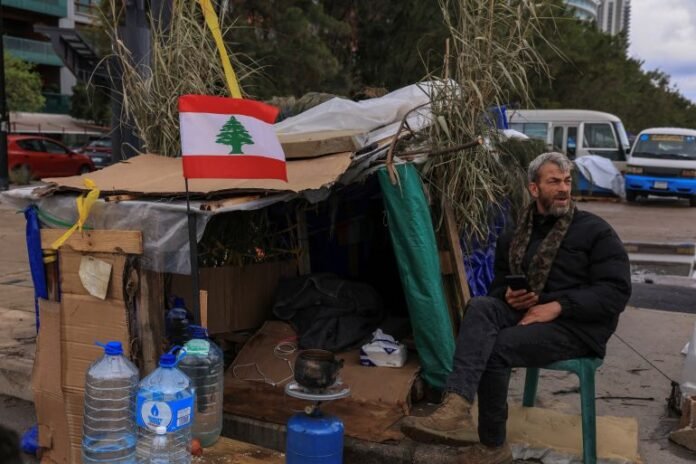
About a quarter of Lebanon’s population has been displaced after Israel’s mass forced evacuation orders from the country’s south and Beirut’s southern suburbs, known as Dahiyeh.
Recommended Stories
list of 3 itemsend of list
Many of the displaced are extremely frustrated and fatigued. And even those who are not displaced are feeling the pressure, with deadly Israeli attacks continuing, petrol prices increasing, business in general slowing down, and little sign that the conflict will end any time soon.
Samiha, a Palestinian teacher who had been living near Tyre, in southern Lebanon, but recently relocated to Beirut, said the experience was “not good at all”. However, with the previous Israeli campaign in Lebanon not long ago, her family came into this round more prepared.
“It’s not the first time for us. Now we know more about where to go.” Still, she maintained, “we don’t know how long this will last and if there is a solution”.
Foreigners most vulnerable
Israel intensified its war on Lebanon again on March 2, after Hezbollah responded to Israeli attacks for the first time in more than a year.
Hezbollah – a close ally of Iran – claimed the attack was retaliation for Iranian Supreme Leader Ayatollah Ali Khamenei’s assassination two days earlier. A ceasefire between Israel and Hezbollah had ostensibly been in effect since November 27, 2024, despite the United Nations counting more than 10,000 Israeli ceasefire violations in that period, and hundreds of Lebanese deaths.
Advertisement
After Hezbollah’s reply, Israel intensified its attacks on the south and declared its intention to occupy southern Lebanon. Israel also issued forced evacuation orders for areas of southern Lebanon, Beirut’s southern suburbs, and a few villages in the eastern Bekaa Valley, leading to a massive displacement crisis of at least 1.2 million people, according to the Lebanese government. Now, Israel has also stated its intent to occupy southern Lebanon and set up a so-called security zone, while destroying more villages along the southern border.
The crisis has hit people who live in Lebanon severely, particularly the country’s most vulnerable people.
“The most vulnerable cases that we’re coming upon are happening, either migrant workers, either Syrians, foreign bodies, basically,” Rena Ayoubi, a volunteer who has organised aid near Beirut’s waterfront, Biel, told Al Jazeera.
She said other people who have suffered deeply in this period include: people with chronic diseases, cancer patients on dialysis, people who cannot access insulin, and displaced people who don’t have access to a fridge to store their medicine.
‘Different in scale and speed’
A series of catastrophes is unfolding, with women, children and those suffering with psychological issues suffering the most, according to a variety of sources, including aid workers, volunteers and UN workers. The humanitarian crisis in 2024 was severe, they said, but 2026 is on a whole different level.
“Now is significantly different in the scale and speed and number of people impacted,” Anandita Philipose, the UN sexual and reproductive health agency (UNFPA)’s representative in Lebanon, told Al Jazeera. “The mass evacuation orders are new. The scale of displacement is new. The fact that civilian infrastructure was targeted is new.”
Many women, in particular, have been displaced not only from their homes but from their healthcare networks, including offices or support systems that will help them through pregnancies.
“Pregnant women do not stop giving birth in the middle of conflict, and women don’t stop having periods in the middle of conflicts,” Philipose said.
Israel’s latest war on Lebanon has so far killed 1,094 people and wounded another 3,119 in Lebanon, according to the country’s Ministry of Public Health. Among the dead are 81 women and 121 children, in just over three weeks.
“Children have yet again been caught up in this escalation, Heidi Diedrich, national director of World Vision in Lebanon, told Al Jazeera. “Children are deeply affected by the violence regardless of their protected status as civilians under international humanitarian law, and regardless of their rights as children. We are deeply concerned that this escalation will continue to impact children in Lebanon for weeks or even months to come.”
Never-ending trauma
At an office building in Beirut, two volunteers sit behind desks waiting for phones to ring. The volunteers are closely monitored by clinical psychologists. On the other end are people calling in for help, many in some of their darkest moments.
Advertisement
This is the office for the National Lifeline in Lebanon (1564) for Emotional Support and Suicide Prevention Hotline, a collaboration between the National Mental Health Programme and Embrace, a nonprofit focused on mental health. 1564 is the phone number that people who require psychological support can dial.
“We’ve been in the worst situation for the past two years,” Jad Chamoun, operations manager at the National Lifeline 1564, told Al Jazeera from the Lifeline centre in Beirut.
“Even when there was a ceasefire, people were still living under the conditions, they were still displaced.”
Even before March 2, about 64,000 people in Lebanon were displaced, according to the International Organization for Migration. According to a March 2025 report from Lebanon’s National Mental Health Programme, three in five people in the country “currently screen positive for depression, anxiety, or PTSD”. And that was before the current intensification.
“The living conditions we’re in is a continuous trauma, because it’s never ending,” Chamoun said. Lebanon went through one of the world’s worst economic crises in 2019, which continues today. In the following years, people in Lebanon experienced the COVID-19 pandemic, the Beirut explosion, mass emigration, and now two Israeli large-scale military campaigns in short succession.
Amid the current violence, the number of calls has increased substantially, Chamoun said, from about 30 a day during 2024’s Israeli attacks to almost 50 a day now. But, he added, that the peak for calls tends to be a few months after the end of a conflict or crisis. Currently, people are in survival mode.
The cascading series of disasters and brutal Israeli aggression has left many in Lebanon near, or well past, their breaking points. Many are falling through the cracks. Volunteers and professionals at efforts like this one are doing what they can to catch as many people as they can.
“We try to sit with them in the darkness, which is what’s heavy around us. We try to share with them this pain,” Chamoun said. “And this is what’s been the heaviest nowadays.”

