



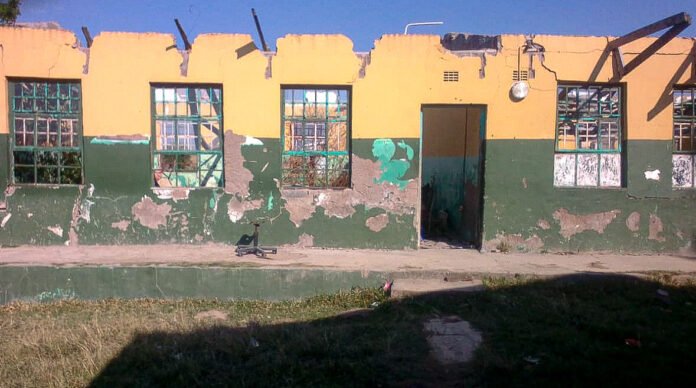

Broken floors, pit toilets and no electricity are exposing learners and teachers to daily health and safety risks at two schools near King William’s Town in the Eastern Cape.
At Lukhozi High School in Zihlahleni Village, learners study in crumbling mud-brick classrooms with broken windows, damaged floors and too few toilets. About 32km away in Zwelitsha, Nonceba Secondary School has been without electricity since September 2025.
School communities say these conditions are not only disrupting teaching and learning, but also affecting health, safety and dignity.
At Lukhozi, the school has only five usable classrooms for about 280 learners. There are two pit toilets for boys and two for girls, while teachers have no toilets of their own.
School Governing Body chairperson Mnoneleli Mazibukwana says the school has been in poor condition for years.

“Can you imagine studying in the cold, with broken windows? This affects the learners’ and teachers’ health,” he says. “There is nothing healthy about breathing the smell of urine and animal dung every morning.”
Mazibukwana, a former learner at the school, says it is painful to watch the school continue to deteriorate.
Mazibukwana says classroom floors have been broken since 2022, forcing learners and teachers to jump over damaged sections to move around the room.
“In 2014, two teachers got injured on their legs because of the broken floor. They still bear scars from those injuries,” he says.
He says the school, which was built by parents using mud bricks in 1976, was badly damaged by heavy rains in 2022. Roofs were affected, and some structures were swept away.
“The Department of Education promised us two prefab classrooms a long time ago,” he says. “A contractor started laying the groundwork, but left within a month. It is only after three years that prefabs were delivered in January, and construction of two classes began last month. They are currently busy building the two prefab classrooms.”
The school is not properly fenced and has no cleaners, he says. Learners sweep animal dung from the grounds in the mornings before classes begin.
“Sometimes, during lessons, a horse will just appear through the window,” says Mazibukwana. “All these things disturb learning. But at the same time, we expect great results from them.”
The problem is not limited to one school. In nearby Zwelitsha, residents say Nonceba Secondary School has been without electricity since September 2025.
The advocacy organisation, Equal Education says that when the 2026 school year started in January, learners at Nonceba returned to dark classrooms with broken doors, damaged ceilings and holes in wooden floors.
“Most schools in the township are in such conditions and have been like that for years,” says Zwelitsha resident Sino Ndindwa.
Ndindwa says Nonceba has been vandalised since the early 2000s and that little has been done to repair the damage. In some cases, he says, parents have donated doors for classrooms.
“I’ve seen multiple officials go to the school on several occasions, but nothing is done,” he says.
Norms and standards
Equal Education says conditions at both schools are unsafe and do not meet the government’s own norms and standards for school infrastructure.
“Not only is the environment at Nonceba not conducive for teaching and learning, but it also has great potential to decrease the morale of the learners,” says Ona Matshaya, head of organising for Equal Education in the Eastern Cape. “The condition at Lukhozi High School is dire and not conducive to teaching and learning.”
The organisation has also say that schools like Lukhozi continue to wait years for safe infrastructure, even when contractors are eventually allocated.
A 2025 South African Human Rights Commission report on sanitation in Eastern Cape schools warns that unsafe sanitation continues to violate learners’ rights to dignity, safety and a healthy learning environment. The report says traditional pit toilets pose “substantial risks to health, safety, and the environment”.
Court ruling
In a landmark 2018 judgment, the Bhisho High Court affirmed that the state has a duty to provide safe and adequate school infrastructure. The minimum standards cover basics such as safe classrooms, water, sanitation and electricity. But years later, school communities say some schools in and around King William’s Town still do not meet those standards.
The ruling followed years of campaigning over unsafe school infrastructure, including schools built with mud, wood and asbestos, and cases where poor sanitation and unsafe buildings put learners’ health and safety at risk.
Health-e News sent questions to the Eastern Cape Department of Education more than three weeks ago about conditions at Lukhozi and Nonceba, delays in infrastructure upgrades, and the lack of electricity at Nonceba. No response had been received by the time of publication.
School communities say urgent action is needed to restore safety and dignity at both schools. They want the department to ensure that learners and teachers are no longer expected to learn and work in hazardous conditions.
Despite these conditions, Lukhozi High School achieved a 97.6% matric pass rate in 2025, with 144 distinctions from 244 learners, ranking among the top-performing schools in the Metropolitan East district. – Health-e News