



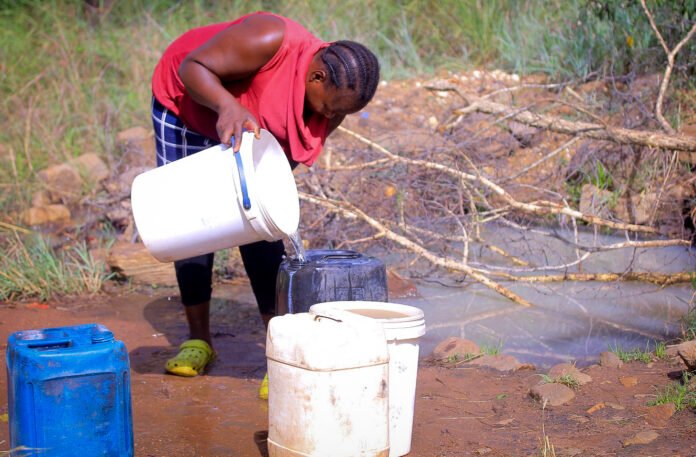

In villages across Vhembe District, the daily search for water has become a matter of survival. For some communities, that means competing with cattle and goats for access to a fountain in the bush.
Beyond the indignity of the situation lies a far darker threat: waterborne diseases that can kill.
With taps running dry for months across municipalities including Makhado, Musina, Collins Chabane, and Thulamela, residents have little choice but to turn to untreated natural water sources shared with animals.
Defney Chauke, a resident of Malamulele in Collins Chabane Local Municipality, describes a reality that has become routine in her community. Each day, villagers make the 3km journey – which can take almost an hour – to fill buckets and containers, then haul them home by wheelbarrow.
“Our taps have been dry for years, so we collect water from the fountain in the bush. We use the water for cooking, washing and drinking,” she says.

Public health risk
A doctor at a local public hospital, who asked not to be named, says boiling water can kill some bacteria. But it does not remove chemical contaminants, heavy metals, or all parasites that may be present in a source shared with livestock.
“Animal waste in and around water sources introduces dangerous bacteria and parasites that cause severe diarrhoea, vomiting, dehydration and, in vulnerable people such as children and the elderly, death,” he warns.
The health implications are not lost on residents.
“Animals also drink from the same water. We have tried to place thorn branches around the fountain to stop cows and goats from entering, but we are still concerned about our health,” Chauke says.
Animal faeces in water sources are a major carrier of E. coli and Salmonella, the doctor says. Stagnant or slow-moving water can also create breeding conditions for mosquitoes, raising the risk of malaria – already a significant burden in Limpopo – as well as bilharzia, a parasitic disease caused by contact with contaminated freshwater.
“Children are among the most vulnerable. Diarrhoeal diseases linked to contaminated water remain one of the leading causes of death among young children in South Africa,” the doctor says. Communities without access to clean water face a disproportionately high burden of preventable illness.
Long-standing issues behind the problem
Vhembe District Municipality spokesperson Moses Shivambu acknowledges the crisis, attributing it to a combination of factors, including prolonged drought and ageing infrastructure.
“Illegal connections and vandalism place significant strain on the distribution network and reduce water pressure to downstream communities,” he says.
While the municipality says it has deployed water tankers, repaired pipelines and installed storage tanks as short-term measures, Shivambu is clear about the dangers residents face.
“The municipality strongly discourages the use of untreated river water for domestic consumption because it may pose serious health risks,” he warns.
However, villagers visited by Health-e News say they do not have access to the short-term interventions Shivambu describes. – Health-e News