


What US-Israeli targets reveal about Iran war goals three weeks in
From degradation of military to efforts to foment unrest, targets show array of objectives but no single endgame.
Save

 By Joseph StepanskyPublished On 20 Mar 202620 Mar 2026
Washington, DC – The administration of US President Donald Trump has offered a carousel of contradicting final objectives for the US-Israeli war with Iran: destroying its regional military might; decapitating its leadership; fomenting dissent; eliminating its nuclear programme.
But beyond the rhetoric, military targets over three weeks of fighting have painted a picture of how the US and Israel are prioritising those goals, while raising further questions about Washington’s final endgame in the conflict and its potentially diverging ambitions from Israel.
Recommended Stories
list of 3 itemsend of list
In some ways, the targets have reflected the Trump administration’s stated multipronged war aims, offering several avenues for Trump to claim some level of success and attempt to disengage.
But how the US and Israel have so far prosecuted the war has also removed many off-ramps in the grinding conflict, opening the door to prolonged escalation, analysts told Al Jazeera.
“President Trump has outlined a wide array of goals,” Jon Alterman, a global security and geostrategy analyst at the Center for Strategic and International Studies (CSIS), told Al Jazeera.
“This will give him the option of stopping the assault whenever he wants,” he said, “but what he won’t be able to do is control what the Iranians do in response.”
“A halt in American bombing alone will neither stop the war nor necessarily open the Strait [of Hormuz], let alone lead to security in the Gulf.”
From ‘shock and awe’ to gasfield strikes
Three weeks in, the fighting has broadly fallen into three phases, according to Hamidreza Azizi, a visiting fellow at the German Institute for International and Security Affairs.
Advertisement
The initial phase represented a kind of “shock and awe” campaign that saw the US and Israel target not only Iran’s traditional military capabilities, but also the country’s political and military leadership. Within hours of launching attacks on February 28, Iran had confirmed the killing of the Supreme Leader Ali Khamenei and a cadre of top Islamic Revolutionary Guard Corps (IRGC) officials.
The approach underscored an effort to “paralyse decision making in the system” and to “pave the way for some sort of regime transformation” that, in the apparent aim of Washington, would lead to the appointment of leaders more amenable to US and Israeli demands, Azizi said.
He described the second phase as the “macro level targeting” of institutions and individuals involved in internal security in Iran. That included targeting “almost every single IRGC headquarters”, as well as the headquarters of the IRGC-aligned Basij paramilitary group and domestic police headquarters.
“So the aim is clear, to erode the capacity of the Islamic Republic to preserve internal security, in order to pave the way for some sort of unrest, either in terms of mass protests again, or the activation of some armed cells from within the country,” Azizi said.
The second phase has also been coupled with heavy bombing in Iran’s western border with Iraq, which has been “interpreted as trying to facilitate the entry of Kurdish insurgent groups, armed groups” that the US Central Intelligence Agency (CIA) has reportedly been supporting, he said.
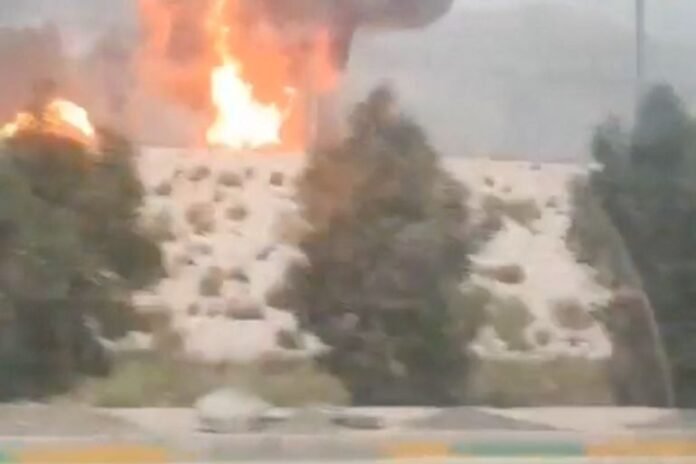
Azizi said Israeli strikes on the South Pars gasfield on Wednesday appeared to signify a new phase in the war had begun, in which the “aim seems to be to also disrupt the government’s ability to provide basic services, especially electricity and gas” to make the situation further untenable for residents of Iran.
The attack sparked immediate retaliation from Iran, including strikes on Qatar’s Ras Laffan gas facility and Saudi Arabia’s Samref oil refinery.
On Wednesday, in his clearest rebuke of the close ally, Trump said Israel had “lashed out” without US approval in launching the attack.
He added that the US “knew nothing about this particular attack”, while condemning Iran for “unjustifiably and unfairly” retaliating against Qatar.
Attacks on missile, drone and naval capacities
To be sure, the US and Israeli campaign has shown a quantifiable emphasis on attacks on Iran’s ballistic missile, naval and drone capacity; its related mobile and communications systems; as well as attacks on IRGC installations, according to Clionadh Raleigh, the founder of the he Armed Conflict Location & Event Data Project (ACLED), which has been tracking the war.
Advertisement
But about 30 percent of attacks focused on what she described as “hyperlocal military and security infrastructure” traditionally used to assert control over the population, Raleigh explained. Iran’s nuclear facilities, meanwhile, have been some of the “least hit” targets.
All told, the US and Israel have conducted 1,434 total “strike events” on Iran, compared with 835 retaliatory “strike events” launched by Iran, according to ACLED data. So-called “strike events” represent a time and location of an attack, but do not count the number of individual weapons used or the number of targets hit in each event.
The Trump administration has said it has hit more than 7,800 targets since February 28, flying more than 8,000 combat missions. It has been said that US forces have damaged or destroyed 120 of Iran’s naval vessels.
On that front, the White House has hailed “massive results” from the war.
“Iran’s ballistic missile capacity is functionally destroyed. Their navy assessed the combat as ineffective. Complete and total aerial dominance over Iran,” it said in a statement this week.
Experts have said that while Iran’s traditional military capacity has indeed been degraded, as evidenced by a steep decline in daily missile and drone strikes launched by Iran, it still has the ability to inflict damage.
Tehran has relied on a so-called “mosaic” doctrine that decentralises its military capabilities and allows for the swift replacement of leaders. That has so far allowed it to continue to wage a war of attrition even as long-term viability remains unclear.
“There’s no question that the air attacks have been monumentally successful in debilitating Iran’s missile strike ability and, of course, their leadership,” Raleigh explained.
“That said, all the other considerations that have come into this conflict … mean that we’re looking at a very long war of attrition in which Iran can stay an active member, sometimes becoming a driving force in a way I don’t think either Israel or the US had anticipated.”
Speaking during a Senate committee hearing on Wednesday, US Director of National Intelligence (DNI) Tulsi Gabbard also gave a sobering account, noting that “the regime in Iran appears to be intact but largely degraded” by the US and Israeli campaign.
“Even so, Iran and its proxies remain capable of and continue to attack US and allied interests in the Middle East. If a hostile regime survives, it will seek to begin a years-long effort to rebuild its missiles and UAV [drone] forces,” she said.
Threshold for ‘victory’?
Jason Campbell, a senior fellow at the Middle East Institute (MEI) and former Pentagon policy staffer, said the war appears to have entered a phase of “incrementalism” that both opens the door to further escalation against military assets and more attacks on civilian infrastructure.
“We’ve seen this escalatory ladder and the pressure to continue to kind of one-up your adversary,” Campbell said. “We’re seeing that on both sides.”
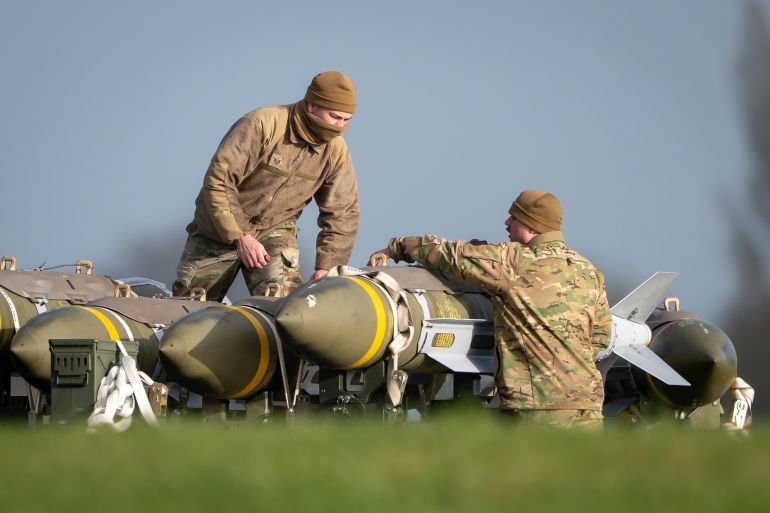
He pointed to the US military’s deployment this week of its GBU-72/Bs so-called bunker-buster bombs to target “hardened Iranian missile sites” along the coast of the Strait of Hormuz, which appear to be the first time the 5,000-pound (2,270kg), deep-penetrating behemoths have been used in the war.
Advertisement
He also highlighted the relocation from the Asia Pacific of 2,000 marines from the 31st Marine Expeditionary Unit, which some have speculated could be part of a plan to seize Kharg Island, Iran’s so-called gateway to the Strait of Hormuz.
Iran’s effective closure of the Strait of Hormuz in response to US and Israeli strikes has represented perhaps the most imposing barrier to any off ramps for the US, Campbell added, with any exit that leaves “Iran as the effective gatekeeper of the Strait of Hormuz … a colossal strategic failure on the part of the US.”
On Thursday, Pentagon chief Pete Hegseth maintained that US strikes on military assets on Kharg Island last week gave Washington “control over Iran’s fate”.
He further pledged Washington would “finish this” as he appealed for $200bn in funding to support the future war effort.
But Campbell questioned whether there was a military solution to taking control of the strait, save for a boots-on-the-ground deployment not only on Kharg Island, but along Iran’s coast, as well.
He said the prospect of 2,000 marines taking and holding significant terrain for an extended period of time “would be very difficult”. They would remain susceptible to Iranian attacks.
A more effective deployment would require tens of thousands of US troops, he said. Then, without a diplomatic solution, “you’re not erasing the threat.”
Nuclear programme
Several experts also agreed that Trump’s objective of destroying Iran’s nuclear capabilities would also be impossible without some form of ground operation.
There have been reports of a few limited strikes on Iran’s nuclear facilities since February 28, although the greatest damage was done during US strikes on the Fordow, Natanz and Isfahan sites during the 12-day Israel-Iran war last year.
At the Senate committee hearing on Wednesday, DNI Gabbard appeared to undercut the Trump administration’s justification for abandoning nuclear negotiations with Iran before launching the war.
Gabbard said in her written testimony that Iran’s nuclear enrichment programme was “obliterated” by US strikes last year. “There have been no efforts since then to try to rebuild their enrichment capability,” she said.
Still, nuclear experts have questioned the viability of completely destroying Iran’s nuclear capabilities.
The chief of the United Nations nuclear watchdog agency, Rafael Grossi, has repeatedly warned of the dangers of strikes on nuclear facilities. On Wednesday, in an interview with NPR, he said it was unlikely that the war could eliminate the “very vast programme” spread across a “very big country”.
Andreas Krieg, an associate professor at King’s College London, said the limits of the US-Israeli airpower strategy so far have been most apparent in the nuclear issue.
“The coalition can damage facilities, degrade infrastructure and push Iran’s programme back, but it cannot easily eliminate the underlying nuclear problem from the air alone, especially if fuel stocks, know-how and hidden capacity survive,” he told Al Jazeera.
“That does not make boots on the ground inevitable, but it does mean that if Washington ever decides that complete elimination rather than delay is the goal, then air power will probably not be enough,” he said.
Diverging goals on regime change?
Meanwhile, while the US and Israel have been fighting the war with Iran in parallel, recent military targets indicate diverging interests.
“They overlap on degrading Iran’s missile forces, air defences, command structure and parts of the nuclear programme,” Krieg told Al Jazeera, “but they diverge sharply beyond that.”
Advertisement
“Israel appears to want a much deeper transformation of the Iranian system, whether that means durable incapacitation or some form of regime destabilisation,” he said,
Both appeared on the same page in early efforts to “decapitate” the Iranian government and military, a strategy that several analysts, including CSIS’s Alterman, had warned would prove ultimately ineffective when relying on airpower alone. The appointment of Khamenei’s son, hardliner Mojtaba Khamenei, as the new supreme leader of Iran has since bolstered that argument.
Israel has more recently appeared to have taken a more liberal approach to Iranian assassinations, notably killing the secretary of the Supreme National Security Council, Ali Larijani, seen by some as a potentially key figure in negotiating a resolution to the war, as well as the intelligence minister, Esmail Khatib.
It has also spearheaded many of the attacks on the Basij paramilitary forces, apparently aimed at fuelling internal dissent.
Trump’s rebuke of Israel over the South Pars gasfield strike further underscored diverging aims on regional destabilisation.
Speaking during a US House of Representatives meeting on Thursday, DNI Gabbard pointed to the diverging aims, the first Trump administration official to publicly do so.
“We can see through the operations that the Israeli government has been focused on disabling the Iranian leadership,” she said.
“The president has stated that his objectives are to destroy Iran’s ballistic missiles launching capability, their ballistic missile production capability, and their navy.”