


17:21
Israel eliminated three top Iranian commanders on Friday as it continues its relentless strikes on Tehran’s repression forces, with help from ordinary Iranians who are rising up against the regime.
Israel continued its intense strike campaign against the Iranian regime’s security forces on Friday by killing the spokesman of Iran’s Islamic Revolutionary Guard Corps (IRGC), Ali Mohammad Naini, the intelligence chief and deputy commander of the Basij forces, Esmail Ahmadi-Moghaddam as well as the commander of the IRGC Aerospace Force, Mehdi Ghorishi, the Iranian media and Israel’s Defence Forces (IDF) announced on Friday.

ADVERTISEMENT
ADVERTISEMENT
Ali Mohammad Naini was known to be the IRGC’s main propagandist, while Esmail Ahmadi-Moghaddam was described as a main pillar of the Basij force, “with a central role in suppressing protests,” Israel said.
Additionally, as Israel keeps pounding the regime forces across Iran, the IRGC in Iran’s East Azerbaijan Province announced that 12 Basij members were killed in a strike in Tabriz on Thursday.
Shortly after these announcements, Iran’s top military spokesman, General Abolfazl Shekarchi warned that “parks, recreational areas and tourist destinations” worldwide won’t be safe for Tehran’s enemies, renewing concerns that Iran could stage attacks beyond the Middle East.
“From now on, based on the information we have about you, even parks, recreational areas and tourist destinations anywhere in the world will no longer be safe for you,” Shekarchi said in a statement quoted by Iranian state television on Friday, which is set to trigger renewed alarms across European security agencies. Qatar and the UAE announced that their security agencies dismantled Iranian operatives cells after the start of the war.
Since the war began, monitors estimate that up to a third of strikes have eliminated scores of IRGC and Basij personnel in a relentless campaign of precision strikes to break the regime’s complex security establishment responsible for the brutal crackdown on protests, and apparently to support regime opponents to return to the streets.
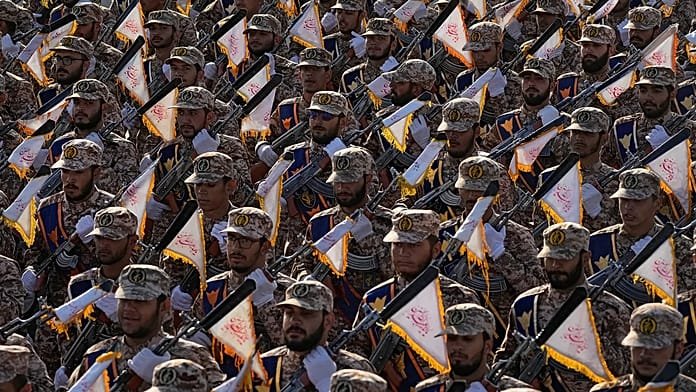
The Basij units, also known as the regime’s moral police, are a paramilitary force of volunteers tasked with enforcing loyalty to Iran’s theocratic rulers across the country. They are linked to the Islamic Revolutionary Guard (IRGC) which is the backbone of the Iranian regime’s security force, responsible for killing and injuring hundreds of opposition protesters before the war.
Basij checkpoints have proliferated across Tehran since the war started. One resident told the Associated Press that there were five or six new checkpoints in his neighbourhood alone and that the Basij forces search vehicles for weapons, examine documents and sometimes demand to look at people’s phones. By manning checkpoints, the Basij helps security agencies to focus on information gathering and arrests.
The strikes on checkpoints began on 11 March, with at least 15 incidents on a single day documented by Armed Conflict Location and Event Data, a US-based monitoring group, quoted by AP.
Social media accounts observed by Euronews since the war started show that ordinary Iranian citizens have been sharing films or photographs of the Basij checkpoints or military hideouts, posting locators, photos or videos on social media in a form of opposition following the regime’s violent crackdown on the widespread protests preceding the war.
Despite the nationwide internet blackout imposed by the regime, Israel is reportedly gathering some of the targeting intelligence from the videos and photos by ordinary Iranians who often tag the Farsi account of the Israeli military, sometimes in the name of protesters who were killed in the area.
According to insiders in Iran Euronews spoke to at the time, as many as 32,000 people were reportedly killed by mid-January after Tehran responded with violence to growing country-wide unrest originally sparked in December by hyperinflation and the cost of living, but then grew into major anti-regime demonstrations.
Euronews’ Persian service observed that a phrase has been trending on Iranian social media saying that every drone that hits a Basij checkpoint “gladdens the souls of dozens of Javid-nam” in reference to the victims of January repression. It also suggests that these strikes provide new momentum and renewed hope for the protest movement.
In a recent move, Israeli intelligence has started appealing to Iranians to keep posting the locators of the regime forces. One of the Israeli messages says: “Don’t underestimate your power. One more location, one less Basij dog. Start sending.”
Residents say security forces still have an intimidating presence in Tehran. War monitors say an intensified crackdown that began with the crushing of January’s nationwide protests continues, often targeting those who take videos of strikes or try to get around a weekslong internet blackout to contact the outside world.
The Iran Human Rights Documentation Center, a U.S.-based group, said people have been rounded up for taking pictures identifying the location of checkpoints, bases and military installations, AP reported. Authorities are also still detaining people linked to the January protests, former political prisoners or members of minorities.
The rights group said it had reports of security forces opening fire at checkpoints. In one incident, two teenage brothers were shot and killed after honking their car horn in celebration of the killing of Supreme Leader Ayatollah Ali Khamenei in the war’s opening salvo.
Nevertheless, over the last days, new videos from Tehran surfaced on social media showing the Basij and IRGC units hiding under bridges, in tunnels and even in empty schools and kindergartens to evade Israeli strikes.
In a recent video, a group of Basij fighters appear to hide under a bridge in Tehran waving a white flag.
Another video from Tehran appears to show security forces changing uniforms to avoid being identified from the air.
The Israeli Defence Force keeps releasing cockpit videos of its airstrikes on the Basij and IRGC forces to show its rate of action, while ordinary citizens continue posting videos showing the aftermath of the Israeli airstrikes.
On Friday, Iranians posted the aftermath of an Israeli airstrike on a Basij compound in Semnan.
As Israel’s strikes are dismantling the Iranian regime’s security system and in growing signs of defiance, social media videos out of Tehran over the last days showed scores of Iranians celebrating the yearly Chaharshanbe Suri, an ancient Persian festival, which is consistently opposed by the regime as young Iranians often use the occasion to protest..
In videos released from the Chitgar neighborhood in western Tehran, security forces can be seen entering an apartment complex with a large convoy of vehicles while residents chant slogans and gunshots can also be heard.
According to the Associated Press, the Basij, Farsi for “mobilization,” has tens of thousands of volunteers under the command of the Revolutionary Guard, being engaged in ideological and political activities, with branches in schools, universities, government institutions and other organizations.
Volunteers, both men and women, work to ensure loyalty to the Islamic Republic which include holding religious lectures or harassing those who flout social restrictions, but they can also be mobilized for state-organized events, including counterprotests.
District-level paramilitary units deploy in times of domestic unrest — like the January protests — armed with everything from batons and electroshock devices to live ammunition.
Iranians describe mass text messages warning against protests while aggressive Basij patrols operate in Tehran, AP reports. On Thursday, Iran announced the execution of three men detained in the January protests, the first such sentences known to have been carried out.
In the last week, semiofficial news outlets have reported the arrest of more than 100 people across Iran, most accused of conspiring with enemy states or sharing media reports with foreign entities. At least 14 were accused of possessing Starlink internet dishes or virtual private network cards. Starlink has been one of the only ways to access the global internet since the unprecedented blackout began on January 8.
The government has also reportedly shut down parts of Iran’s internal internet and revoked some VPN cards given to people with specialized jobs.