





Why aren’t gold prices rising, despite Iran war uncertainty?
Gold holds steady despite war and rising oil prices, as its recent volatility and a strong dollar reduce its safe-haven appeal.


Published On 17 Mar 202617 Mar 2026
Save
As the war on Iran entered its 18th day on Tuesday, the price of gold, usually considered the safe-haven asset in times of uncertainty, has remained unexpectedly steady.
Since the United States and Israel first launched strikes on Iran on February 28, the conflict has escalated across the region, sparking concerns about the knock-on effect for the global economy.
Recommended Stories
list of 3 itemsend of list
On March 2, Ebrahim Jabari, a senior adviser to the commander-in-chief of Iran’s Islamic Revolutionary Guard Corps (IRGC), announced that the Strait of Hormuz – through which 20 percent of the world’s oil and gas is transported – was “closed”; a move that sent oil prices soaring above $100 per barrel.
Stock prices have also fallen over the past two weeks amid uncertainty over the war on Iran, but gold prices have remained steady.
What are gold prices doing?
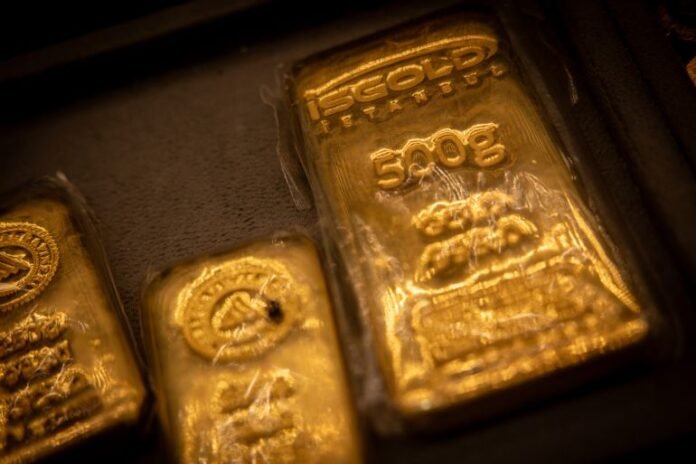
Gold has remained broadly steady at around $5,000 an ounce in recent days.
On Tuesday, spot gold was almost flat at $5,001.36 per ounce at 11:00 GMT. Spot gold is the price at which physical gold is bought and sold for immediate delivery.
US gold futures for April delivery rose just 0.1 percent to $5,005.20.
Is this unexpected?
Yes. This lack of movement is surprising, given that gold prices typically shoot up during economic crises as investors look for safe havens to shelter their cash.
This is especially true during periods of global conflict.
For example, when Russia launched its full-scale invasion of Ukraine, gold prices skyrocketed, Remi Bourgeot, economist at the French Institute for International and Strategic Affairs in Paris and author of analysis platform Epistelem, told Al Jazeera.
Advertisement
The subsequent sanctions imposed on Russia by Western nations created “a wave of panic” among central banks and “completely changed the dynamic behind gold prices”, with countries like China embarking on a historic buying streak to reduce their dependence on the US dollar, he said.
However, with the US-Israeli war on Iran, there has been a different response.
Why have gold prices remained flat?
Traders may be anticipating that the US Federal Reserve will halt interest rate cuts and perhaps even raise rates in response to rising inflation, James Meadway, a former economic adviser to the United Kingdom’s shadow chancellor and currently council member of the Progressive Economy Forum, told Al Jazeera.
“That makes dollar assets more attractive and gold, which pays no interest, less so,” Meadway explained.
He added that investors have expected the US to cut interest rates for some time.
Another factor is that gold was already performing well at the start of this year.
“Gold had risen so much before that it is reacting less now to the war,” Meadway said.
Rebecca Christie, a senior fellow at the Bruegel think tank, echoed this, noting that gold has been trading far above historic levels this year.
“There are other factors in play: because the dollar has strengthened, and because gold is traded in dollars, it may be harder for interested investors to push the price up,” Christie said.
“Also, a rising dollar provides an alternative safe-haven choice, and higher oil prices probably will lead to higher inflation, which also will make the dollar more attractive.”
Is gold still a safe bet?
Not at the moment.
“It’s not seen as much of a hedge against the uncertainty as it was two years ago,” Bourgeot said.
“I think there’s really a great deal of understanding at this point that gold has become a very speculative asset,” he said, adding that typical gold investors, which include central banks, tend to be more risk-averse and may have been spooked by the “volatility” of gold in the current climate.
What’s next for gold?
Experts say it is difficult to make predictions given the uncertainty in the Middle East.
“For now, it seems like the biggest thing holding gold back from rising further is because it has already risen so much,” Christie said.
For the price of gold to shift dramatically, Meadway said two things would need to happen.
“First would be a clear indication from the Federal Reserve, which will be getting a new, likely more Trump-friendly chair in May, that interest rates may be cut further, despite inflationary pressure,” he said.
Advertisement
“The second would be a change in perception as to the length of the war; at present, there is still some belief this will be ended fairly quickly, but the longer this drags on, and the more the damage spreads, the more attractive gold will start to appear,” he said.

