



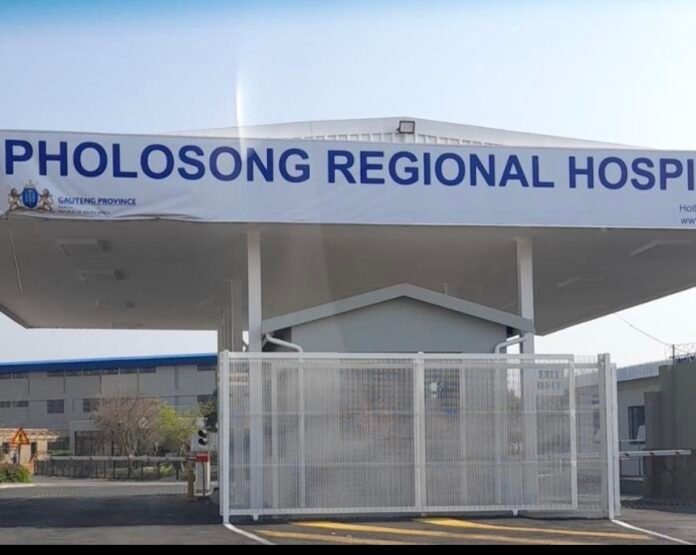
GAUTENG: Patients at Pholosong Regional Hospital in Tsakane, Gauteng, have been without hot water for nearly three months, leaving patients unable to bathe.
In December 2025, the facility’s boiler broke down. Although repairs were reportedly completed in early January, hot water has still not been restored.
When Heath-e News visited the facility, visitors were seen bringing in kettles to heat water for their relatives. Those without family support are often left unable to bathe at all.
One patient, who was admitted in September 2025, says the problem has persisted since January 2026. “I haven’t taken a proper bath because I can’t bathe with cold water. Most of the guys here also don’t take a bath,” he says.
The body odour in his ward was difficult to ignore.
Nokuzola Magona, whose brother was recently admitted, says she’s worried about the risk. “I am scared of infections because from the stench in the ward, it’s evident that most of the patients don’t bathe. You cannot expect someone who is sick to bathe with cold water.”
Blame shifting
The Gauteng Department of Health says the hot water problem is no longer related to the boiler.
Department spokesperson, Nokuthula Hlophe, tells Health-e News the boiler broke down on 29 December 2025 and repairs were completed by 8 January 2026. However, she says the hospital cannot produce hot water because the municipal water supply does not have enough pressure to operate the system.
“The unavailability of hot water is not due to boiler infrastructure failure. Instead, it is Ekhurhuleni municipality that has failed to ensure water supply, with pressure and volume required to operate the system”, she says.
Hospital staff and patients say the water supply is inconsistent, and that the facility sometimes goes without water entirely.
The Ekurhuleni municipality has not responded to questions sent by Health-e News.
Infection control
Pholosong is a 300-bed hospital that serves nearly one million people from Tsakane, Kwa-Thema and Duduza.
In healthcare settings, warm water is a pillar of Infection Prevention and Control (IPC). Patients recovering from surgery, chronic illnesses, or those with weakened immune systems are particularly vulnerable to complications when basic hygiene is compromised.
Midwife Lindi Davis, who doesn’t work at the hospital, explains to Health-e News that hot water is not a luxury, but a fundamental requirement for safe and dignified healthcare delivery.
“Hygiene is the foundation of what we do,” she says. “How do you expect a patient to bathe with cold water? How are we supposed to properly clean and dress wounds? You cannot adequately disinfect your hands with cold water.”- Health-e News