


13:44
Hundreds of thousands flee southern Lebanon after Hezbollah fires on Haifa, facing chaotic evacuations, profiteering landlords and limited state aid.
Hezbollah fired its first missile towards Israel’s Haifa at dawn on 2 March, some three days after the Iran war began with initial US-Israeli strikes.

ADVERTISEMENT
ADVERTISEMENT
Within hours, hundreds of thousands of Lebanese people fled from the south as Israel issued evacuation orders and automated calls warned residents to leave immediately.
According to the United Nations Children’s Fund, this prompted about 700,000 people, including about 200,000 children, to leave their homes.
Many feared a repeat of 23 September 2024, when Israel launched Operation Northern Arrows with hundreds of air strikes on the south, the suburbs and the Bekaa Valley.
Within hours, roads turned into open gridlock due to suffocating traffic congestion that lasted more than two days. Those who fled were trapped in their cars, while those who stayed faced air strikes.
The Lebanese state did not send personnel to organise traffic on the day people panicked, nor did it declare a state of emergency to facilitate movement or ensure safety, some among those displaced said.
Many expressed the feeling that the authorities in Beirut had abandoned them, leaving them to face the crisis alone.
Although Lebanese authorities announced the distribution of daily hot meals and limited financial aid a week after the start of the war, these measures remain insufficient to address the scale of the humanitarian crisis.
The number of displaced people in shelters exceeds 120,000, while announced aid only covers part of basic needs such as food, rent and health care.
On Wednesday, the Ministry of Social Affairs announced receipt of the first aid plane from the European Union through UNICEF, which includes 45 tonnes of emergency supplies to support 400,000 affected people. The shipment includes first aid kits and children’s supplies.
Not so warm welcome
The crisis has revealed deep divisions in Lebanese society and its citizens. Some provided aid and opened homes to displaced people, while others raised rental prices to $2,000 per month, requiring several months in advance.
Among the critics, there have been calls to expel displaced people, some of whom are Hezbollah supporters, holding them responsible for the group’s “wrong decisions” and involving Lebanon in a new war that it “cannot win”.
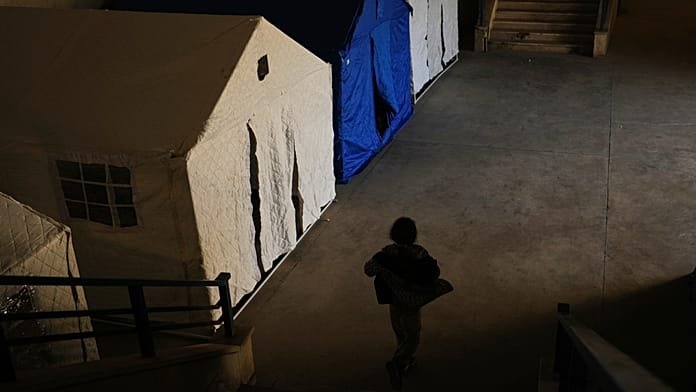
Many displaced people have been forced to use schools as temporary shelters, or stay in their vehicles or on the roadside.
A statement attributed to the mayor of Beirut, who protested the presence of displaced people on the pavement in the Rouche area, Beirut’s famed waterfront, said: “We bought apartments for millions of dollars to overlook the sea, not the tents of refugees.”
Batoul, 26, a displaced person from the town of Shu’aitieh in southern Lebanon, about five kilometres from the border with Israel, said the feeling of fear has not left her since Lebanon was declared to be at war. A mother of two, protecting her children was her main concern.
“We spent 12 hours on the road to cover a distance of only 85 kilometres until we reached the town of Kifoun in the Aley district of Mount Lebanon,” Batoul told Euronews. “Every moment I felt unable to reassure my children.”
Upon arrival, Batoul encountered another face of suffering. Homeowners demanded $1,500 in rent for a small three-room house, plus additional commissions, while four families shared the space.
“We had no choice but to stay in our cars or on the streets,” Batoul said. “We had to accept the contract even though the house was not worth the amount.”
Prices in the country are often expressed in US dollars due to the high volatility of the domestic currency, the Lebanese pound, which fluctuates daily, particularly in times of crisis.
‘What if donations stop?’
In response to the humanitarian crisis and the state’s failure to act, a group of young people formed cells to distribute food and basic needs to the displaced.
Volunteer Walaa Taleb, 23, told Euronews her initiative began with a group of influencers she met on social media. “We started collecting donations spontaneously through our personal accounts, and we went down to the street to listen to people’s needs and try to provide them,” she said.
“It is not only the war that forced people to take to the streets, but another reason is the refusal of some Lebanese to receive refugees in their neighbourhoods, and the rise in room rents to levels that far exceed the average salary in Lebanon,” Walaa said.
“The Beirut municipality’s treatment of displaced people was unfair, as they were expelled from some places under the pretext of preserving the ‘sea view’, while forcing many of them to return to the southern suburbs and the Bekaa Valley and sit under danger,” she said.
Schools taking in displaced people are accommodating more people than capacity allows, Walaa said.
In some cases, 500 people are spread across only 28 rooms, with each family separated by a plastic sheet. However, their situation is still better than that of those who had to stay on the streets.
Walaa said she sees the same scenes as in the previous conflict. “Most of the displaced have taken refuge in the same schools they went to in the 2024 (Israel-Hezbollah war).”
“In the previous fighting, I recognised a pregnant woman, and today I saw her in the same school, but with her baby.”
“We are now distributing meals from charitable kitchens thanks to donations, but we fear that the momentum of support will diminish if the war is prolonged,” Walaa said.
Some schools, such as the Hariri School in Beirut, accommodate more than 1,200 people and need to engage about six organisations a day to provide meals, so what if donations stop?” she concluded.