



10/03/2026 – 17:27 GMT+1
As NATO’s logistical hub in Europe, Germany already plays a key role in moving troops and supplies in the event of an emergency declared by the alliance.
An Airbus A400M from the German Air Force sits on the tarmac at Berlin Brandenburg Airport. The aircraft has arrived from a deployment scenario in Lithuania, where Germany’s 45th Battletank Brigade is stationed to help defend NATO’s eastern flank against a potential Russian attack.

ADVERTISEMENT
ADVERTISEMENT
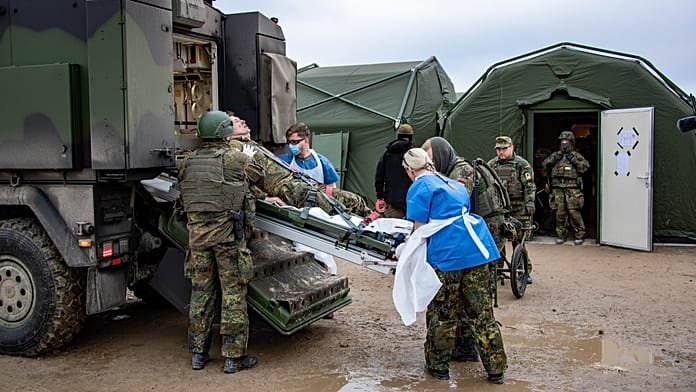
Through the open rear ramp, medics carry a wounded soldier on a stretcher and hand him over to emergency teams from St John Ambulance and the Maltese aid service. From there, he is registered and taken to hospital for treatment in Germany.
For now, it’s only a drill.
As part of the German military’s 2026 Quadriga drills, the Bundeswehr is running through the so-called rescue chain for wounded soldiers during the Medic Quadriga exercise together with civilian emergency services, covering the entire route from the deployment area in Lithuania to treatment in Germany.
The Bundeswehr describes it as the “most complex” and “largest” medical exercise carried out since the start of Russia’s full-scale invasion of Ukraine in 2022.
‘Joint strategic stress test’
The exercise aims to boost the Bundeswehr’s operational readiness and response capability while strengthening cooperation with civilian partners in the healthcare sector, including St John Ambulance and the aid agency Malteser International.
For the first time, the entire military medical evacuation chain was tested, from treating the wounded in the operational theatre in Lithuania to their care in German hospitals. A military rescue chain is a coordinated system designed to ensure that casualties receive rapid and continuous treatment, from the site of injury through to hospital care.
Around 1,250 people took part in the exercise, including roughly 1,000 military personnel and 250 staff from civilian organisations.
Participants included the Federal Office of Civil Protection and Disaster Assistance (BBK), the German Red Cross, Johanniter, the German Life Saving Association (DLRG), ADAC Air Rescue and the Berlin Senate. The MedEvac Airbus, effectively a flying intensive care unit operated by the German armed forces, had originally been scheduled to transport the exercise casualties from Lithuania to Berlin last week.
However, due to the current security situation in the Middle East, the flight had been cancelled at short notice. The aircraft is currently on “operational standby.”
Despite the flight being cancelled, a number of exercise casualties were brought to a centre near Berlin’s Airport last Friday, where they were registered, medically assessed and treated according to the severity of their injuries.
As Surgeon General Dr Ralf Hoffmann explained, in a real emergency evacuations would not rely on aircraft alone, but also on trains.
“Our aim is to have trains available by 2028 at the latest that can be used to transport the wounded,” he said.
He pointed to the war in Ukraine as an example, where around 90% of patient transfers are carried out by rail, showing that trains are among the most important means of transport in crisis zones.
During the Medic Quadriga exercise, however, the airport served as the central hub of the rescue chain. The process begins there with checks to determine whether chemical or biological agents were involved. If necessary, the wounded must be decontaminated before undergoing their initial medical assessment.
This is followed by an initial examination and medical triage, after which the patients are handed over to emergency teams. They then coordinate the onward transfer to nearby civilian or military hospitals. The wounded are finally transported by ambulance or helicopter to hospitals across Berlin and Brandenburg.
‘You can only rely on what you’ve practised’
Hoffmann added that “it’s important that we are able to deal with and care for large numbers of wounded in an emergency”.
In the event of a conflict on NATO’s eastern flank, up to 1,000 casualties per day could need to be transported from the Baltic states to Germany.
“Our calculations show that we would need around 15,000 acute care beds in the system, taking hospital stays into account. In my view, that is manageable if we prepare for it in good time,” he said.
Germany’s Defence Minister Boris Pistorius, who visited the exercise last Friday, explained that the effort follows a simple credo: “You can only rely on what you’ve practised. And only what you train and rehearse in peacetime can you master in times of tension and defence.”
According to the defence minister, the exercise serves as a “joint strategic stress test,” highlighting Germany’s role as a logistical hub in the event of a crisis because of its central location.
NATO’s logistics hub
In the event of war, Germany is expected to become NATO’s central logistics hub. This is set out in the so-called Operational Plan Germany (OPLAN DEU). Under the plan, up to 800,000 troops could be moved through German territory to NATO’s eastern flank in an emergency.
According to the Wall Street Journal, OPLAN DEU consists of a classified document of around 1,200 pages. It was drafted roughly two and a half years ago at the Julius Leber Barracks in Berlin and is now being implemented “at full speed.”
The aim of the plan is to ensure that political decisions in a crisis or conflict can be taken quickly, in line with constitutional procedures and in close coordination, allowing for a rapid response. However, the Wall Street Journal reports that implementation could face major obstacles, including ageing infrastructure such as dilapidated bridges, ports at risk of structural failure, gaps in military capabilities and insufficient coordination with civilian authorities.
Rescue chain in action
The US-Israeli military operation against Iran has been ongoing for more than a week now and alongside US bases in the Middle East, Germany is also playing a role: Ramstein Air Base is one of the US military’s most important hubs in Europe, including for the medical evacuation of wounded personnel.
It shows how a military rescue chain would operate in a real emergency. Much like in a potential crisis on NATO’s eastern flank, the process begins in the operational theatre, where medics and field hospitals provide the first treatment.
Seriously injured soldiers are then flown out on strategic transport aircraft – often Boeing C-17 Globemaster III planes – as part of the so-called “Aeromedical Evacuation System.”
Many of these flights first land at Ramstein Air Base. From there, patients are transferred to the nearby Landstuhl Regional Medical Center, the largest US military hospital outside the United States.