


10/03/2026 – 15:15 GMT+1
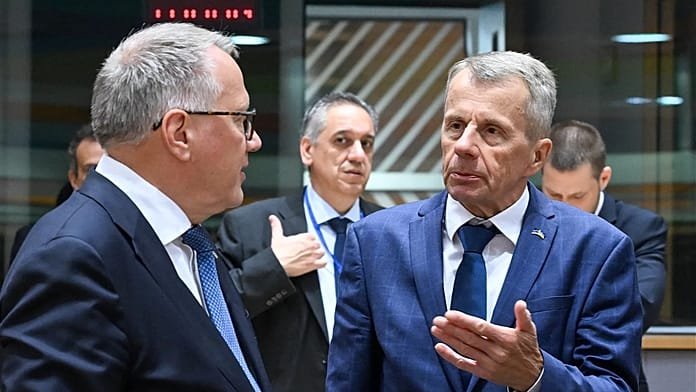
At a meeting in Brussels on Tuesday, the 27 EU finance ministers considered the economic consequences of the war in Iran. Interviewed by Euronews, Estonian Minister Jürgen Ligi said he believed the bloc could rise to the challenge.
International policy issues are on the table for European Union finance ministers. The 27 ministers met in Brussels on Tuesday, where the economic impact of the war in Iran was the main topic.

ADVERTISEMENT
ADVERTISEMENT
Oil prices briefly surged to their highest level since 2022, nearing $120 a barrel, a day after Iran’s Assembly of Experts appointed Mojtaba Khamenei as supreme leader to succeed his late father.
But prices fell sharply after US President Donald Trump said on Monday that the war against Iran could be short-lived and that Washington was considering waiving oil-related sanctions on certain countries to ease pressure on crude markets.
Yet despite the energy price volatility, Estonian Finance Minister Jürgen Ligi told Euronews that the EU has the means to respond to the challenge.
“The big economic problem, of course, is in the unpredictability and instability”, he said, “but we are sure we can cope with it”.
Despite the crisis in the Middle East, the Estonian minister called on his partners not to forget Ukraine. For Ligi, the Russian threat remains the main danger to the EU, and he condemned Hungary and Slovakia’s refusal to allow the bloc’s €90 million loan to Kyiv to go ahead.
Budapest has blocked the emergency loan over what it calls “blackmail” over the damaged Druzhba pipeline, which it uses to import Russian oil. The row is escalating just as Hungary prepares for a general election in April.
In this political battle, Hungarian Prime Minister Viktor Orbán can count on the support of his Slovak counterpart, Robert Fico, who has said Slovakia is ready to block the European Union’s €90 billion loan package after April if Orbán loses power and Kyiv fails to restart oil supplies through the Druzhba pipeline.
“It’s completely cynical by a couple of countries to block” the loan “because of microscopic inconveniences, sanctions to Russia, cost to their citizens”, said the Estonian Finance minister.
Ligi would have preferred to use frozen Russian assets to help Ukraine rather than a loan. The assets are worth about €210 billion across the bloc. The majority, €185 billion, is held at Euroclear, a Brussels-based depository. Nevertheless, the minister expressed optimism that Kyiv’s financing needs will be met.