


Trump’s endgame in Iran: Regime change without US ‘boots on the ground’
Analysts say it would be difficult, if not impossible, to bring down the Iranian system with US-Israeli air power alone.

Published On 4 Mar 20264 Mar 2026
Save
Washington, DC – Hours after the United States and Israel unleashed their bombing campaign against Iran on Saturday, President Donald Trump said that all he wants from the war is “freedom for the people”.
Analysts say that despite this claim and other objectives articulated by US officials, Trump appears to be seeking to collapse the ruling system in Tehran.
Recommended Stories
list of 3 itemsend of list
Kelly Grieco, senior fellow at the Stimson Center think tank, told Al Jazeera that achieving such a sweeping political shift will be difficult – if not impossible – without troops on the ground.
“It seems like they’re not willing to pay certain costs to achieve regime change, so there’s sort of a set of secondary goals that perhaps will be enough if they can’t achieve that through air power alone,” Grieco said.
After the opening US-Israeli strikes, Trump told the Iranian people that their “moment of freedom” is at hand.
“When we are finished, take over your government. It will be yours to take,” he said, suggesting that the US will take down the Iranian regime.
Matthew Duss, the executive vice president at the Center for International Policy, stressed that air strikes alone cannot collapse the Iranian ruling system.
“You can damage buildings; you can damage the regime, but we don’t have examples of when air power alone has achieved regime change,” Duss said.
A NATO-led air campaign in Libya in 2011 managed to dislodge Muammar Gaddafi from power, but Libyan rebels led the offensive on the ground that removed the regime.
While Trump and other US officials have called on Iranians to rise up against their government, as of now, there does not appear to be any meaningful force on the ground capable of taking on the Islamic Republic system.
Boots on the ground?
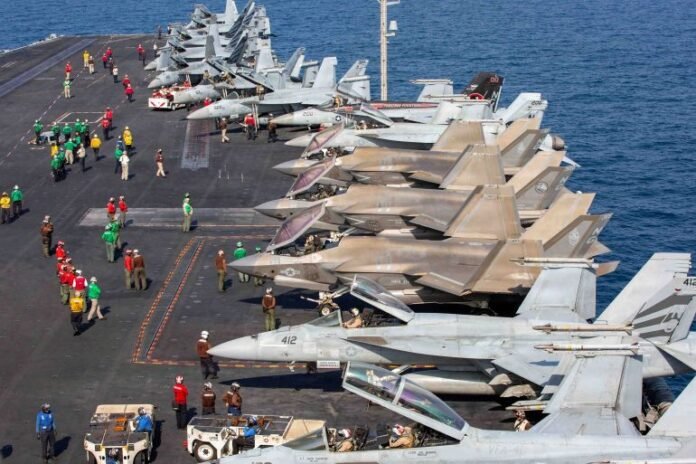
While the US has kept the door open for the involvement of ground troops in the war, the move would pose an increased risk to American forces and mark a stark departure from Trump’s stated preference for swift military campaigns.
Advertisement
“The war is already unpopular, even without any American boots on the ground in Iran,” said Duss.
A recent Reuters survey suggested that only about one-quarter of Americans support the war.
Duss drew a contrast between the ongoing conflict and the 2003 invasion of Iraq, which had more than 55 percent support from the US public, according to various polls.
“I would imagine that as this war continues, especially if US troops are put on the ground, that support will drop even more,” Duss told Al Jazeera.
On Tuesday, Democratic Senator Richard Blumenthal told reporters after a classified hearing with administration officials that he fears that the US may be heading towards a ground operation in Iran.
“I am more fearful than ever after this briefing that we may be putting boots on the ground and that troops from the United States may be necessary to accomplish objectives that the administration seems to have,” Blumenthal said.
Other objectives
Over the past few days, US Secretary of State Marco Rubio and Pentagon chief Pete Hegseth have articulated more modest goals than regime change in Iran: destroying the Iranian nuclear and drone programmes as well as the country’s navy.
Rubio has argued that Iran was building a large missile and drone arsenal to “achieve immunity” and deterrence against foreign attacks that would allow it to build a nuclear weapon.
For his part, Hegseth has emphasised that the bombing campaign in Iran will not turn into a “forever war”.
“We’re ensuring the mission gets accomplished, but we are very clear-eyed – as the president had been, unlike other presidents, about the foolish policies of the past that recklessly pulled us into things that were not tethered to actual, clear objectives,” he said.
Grieco, however, noted that Trump’s own objectives have been unclear.
“What is this all for? What are we trying to achieve? The administration certainly has not done itself any favours in the fact that they don’t seem to have a consistent narrative or message on this,” she told Al Jazeera.
Senator Elizabeth Warren, a Democrat, emerged from a briefing with Trump officials on Tuesday with a similar assessment.
“It is so much worse than you thought. You are right to be worried,” Warren said in a video message.
“The Trump administration has no plan in Iran. This illegal war is based on lies, and it was launched without any imminent threat to our nation. Donald Trump still hasn’t given a single clear reason for this war, and he seems to have no plan for how to end it.”
The US and Israel launched the bombing campaign against Iran early on Saturday, killing Supreme Leader Ali Khamenei, several top officials and hundreds of civilians.
Advertisement
The conflict quickly spread across the Middle East, with Iran lashing out against Gulf countries, launching drone and missile attacks at US assets as well as energy and civilian targets.
Tehran has also been targeting Israel with missile volleys.
Iran-allied groups in Iraq joined the war as well, claiming drone attacks against US-affiliated targets. Hezbollah in Lebanon also entered the fray amid reports that Israel was planning an invasion of the south of the country.
Weeks or ‘far longer’
Despite Hegseth’s insistence that the war is not open-ended, the Trump administration’s timeline for the conflict has been elastic.
Trump has said that the US is ahead of schedule in completing its mission as the conflict expands. At the same time, he said the war could last four to five weeks and “far longer”.
The US president’s allies have also been hailing the war as a success, predicting that the Iranian system will soon fold.
“We are not there yet but, in my view, it’s not if this terrorist regime falls in Iran — it is only a matter of when,” Republican Senator Lindsey Graham wrote on X after a call with Israeli Prime Minister Benjamin Netanyahu.
Graham said the “gateway to peace that would be opened” after the Iranian regime falls and ties between Israel and Arab states would take the region to a “new level of prosperity and security”.
However, Duss said it is hard to assess US progress in the war because Trump “has not been clear yet what the objectives really are”.
“You really can’t judge whether we’re ahead of time or behind time on those objectives. That’s the problem here,” he said.
“They didn’t bother to build any case for why this war was necessary. They certainly did not bother to explain what they hope to achieve and how and when. So all we have is just this killing.”
With the war still in its first week, it is starting to appear like a longer conflict than the decisive strikes Trump prides himself on, such as the abduction of Venezuela’s Nicolas Maduro in January and the strikes against Iran’s nuclear facilities in June.
“I think the problem here is that he seems to have become enamoured with air power and what he thinks it can achieve,” Grieco said of Trump.