


Will the US put ‘boots on the ground’ in Iran?
US President Donald Trump hasn’t ruled out ground troops in Iran, but experts expect targeted special ops over an invasion.

 By Mohammad MansourPublished On 4 Mar 20264 Mar 2026
Save
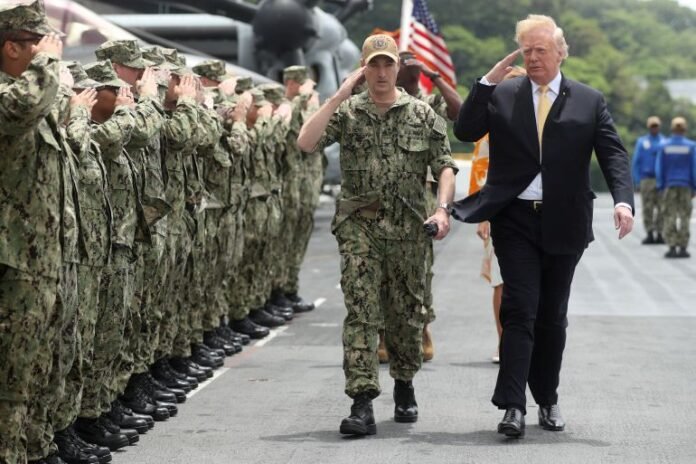
When US President Donald Trump casually floated the idea of putting US “boots on the ground” in Iran, he openly defied a longstanding presidential taboo. “Like every president says, ‘There will be no boots on the ground’. I don’t say it,” Trump declared amid the ongoing US-Israeli strikes on Iran.
But while the political rhetoric from Washington hints at a sprawling conflict, military experts argue that the reality on the rugged Iranian terrain will look vastly different from a traditional invasion.
Military and strategic analyst Colonel Nidal Abu Zeid told Al Jazeera it is unlikely the US is contemplating a traditional ground invasion involving tanks and massed infantry, but rather a different pattern of warfare.
‘Boots on the ground’ vs ‘pick-up’ operations
In his interview with The New York Post on Monday, Trump left the door open for the arrival of ground forces while expressing confidence in the current aerial campaign, dubbed “Operation Epic Fury“.
“I don’t have the yips with respect to boots on the ground – like every president says, ‘There will be no boots on the ground.’ I don’t say it,” Trump said following the strikes that killed Supreme Leader Ayatollah Ali Khamenei and dozens of other officials. “I say ‘probably don’t need them,’ [or] ‘if they were necessary’.”
US Secretary of Defence Pete Hegseth echoed this at a Pentagon news briefing, confirming no US troops are currently inside Iran but leaving the option on the table. “You don’t have to roll 200,000 people in there and stay for 20 years,” Hegseth said.
Advertisement
According to Abu Zeid, Hegseth’s and Trump’s comments align with what is militarily known as “pick-up” or selective operations. This involves limited efforts by special forces infiltrating specific points to execute precise sabotage or intelligence-gathering missions, followed by rapid extraction.
A traditional invasion to occupy territory is not viable, Abu Zeid said, citing Iran’s complex geopolitical environment, rugged geography and demographic density, all of which provide Tehran with a distinct defensive advantage. He noted that Israel has also previously declared a ground operation in Iran to be impractical.
The nuclear pretext and a shifting timeline
Trump revealed that the decision to launch the joint US-Israeli strikes came after “final talks” in Geneva collapsed on Thursday. The trigger, he claimed, was intelligence showing Iran had surreptitiously moved its nuclear enrichment programme to a “totally different site”.
In June last year, Trump had claimed that US strikes, known as “Operation Midnight Hammer,” had “obliterated” known Iranian nuclear facilities. “So then we found them working on a totally different area, a totally different site, in order to make a nuclear weapon through enrichment – so it was just time,” Trump said.
Trump said the operation is “way ahead of schedule”. Originally estimating the war would last around four weeks, Trump said the primary objective of eliminating the leadership structure – killing 49 top officials – had been achieved in a single day.
However, Abu Zeid pointed out that Trump’s initial reference to a four-week timeline is not merely operational; it is tied to US domestic law. The US Constitution restricts the president’s authority to wage war beyond 30 days without Congressional approval, making the “four-week” window a critical legal and political calculation.
The missile war and naval propaganda
While the Iranian command structure has taken a severe hit, Tehran has continued to retaliate. At least six US service members have been killed in action during the conflict with Iran, according to the US military.
Simultaneously, Iran’s Islamic Revolutionary Guard Corps (IRGC) claimed to have fired four cruise missiles at the US aircraft carrier USS Abraham Lincoln, which is stationed in waters close to Iran. Abu Zeid dismissed this claim as media “propaganda” designed to target the morale and prestige of the US military.
He explained that the carrier is protected by advanced RIM-116 Rolling Airframe Missile systems capable of high-altitude interception, backed by a multi-layered defensive umbrella from escorting destroyers. Furthermore, US reconnaissance aircraft, notably AWACS early-warning planes, maintain constant surveillance, making undetected missile launches highly improbable.
Advertisement
Approximately 72 hours into the confrontation, Abu Zeid said, a drop to a medium-intensity level in Iranian missile attacks was observed. He attributed this decline to the likely destruction of Iranian launch platforms. While higher estimates suggest Iran possesses about 3,000 ballistic missiles, it relies on only a few hundred launchers. In a missile war, the destruction of platforms is just as critical as the depletion of the missile stockpile itself.
Domestic pushback
Despite the military momentum, Trump faces scepticism at home. A Reuters/Ipsos poll showed only 27 percent of Americans approved of the strikes, while a CNN/SSRS poll placed approval at 41 percent.
Trump dismissed the numbers, insisting a “silent majority” supports the preemptive action to prevent “crazy people” from acquiring a nuclear weapon and citing a 47-year history of Iranian hostility that includes the 1979 embassy hostage crisis and the 1983 Beirut barracks bombings.
Meanwhile, Abu Zeid noted that US and Israeli intelligence may have underestimated Iran’s ability to quickly repair its chain of command. By adopting a doctrine of “centralised planning and decentralised execution”, Tehran has managed to absorb the initial shock and maintain its missile barrage despite heavy US electronic jamming and technological superiority.
Yet, how long Iran can sustain this strategy of “fire flooding” remains the defining question. As Trump boasts of completing a four-week leadership decapitation in a single day, the clock continues to tick for both sides. Ultimately, the next phase of this war may not be decided by tens of thousands of US boots marching across Iranian soil, but by which side runs out of time – and launch pads – first.