


Who are the council members temporarily in charge of Iran?
Until Khamenei’s successor is picked, the three-member leadership council, including Ayatollah Alireza Arafi, will lead Iran.

Published On 1 Mar 20261 Mar 2026
Save
Iranian authorities have announced a three-member interim leadership council to run the government after the killing of Supreme Leader Ali Khamenei in Israeli-United States strikes.
Iran’s government pledged to avenge the killing on Saturday of Khamenei, who had been in power for nearly four decades. Tehran has since targeted Israeli and US assets located across Gulf countries in retaliatory strikes.
Recommended Stories
list of 4 itemsend of list
While US President Donald Trump has said he wants a change in Iran’s government, the religious leaders of Iran moved on Sunday to start the process of choosing Khamenei’s successor.

What is the interim leadership council?
Article 111 of Iran’s Constitution authorises a temporary leadership council to assume the supreme leader’s duties until a successor is elected.
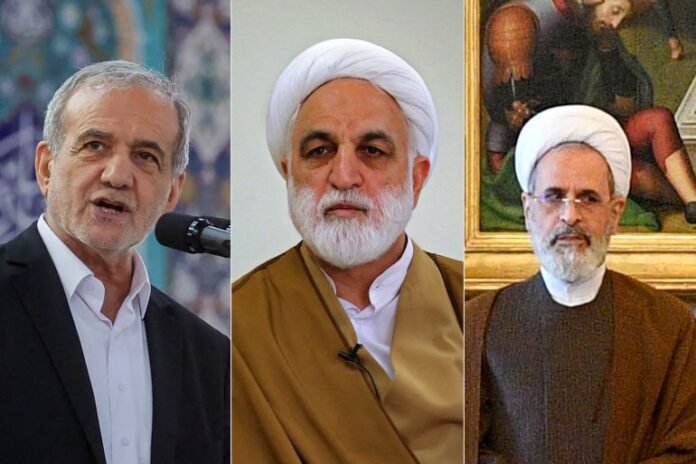
That council will consist of President Masoud Pezeshkian; the chief justice of the Supreme Court, Gholam-Hossein Mohseni-Ejei; and a member of the Guardian Council, Ayatollah Alireza Arafi.
So who are these three figures who will temporarily run Iran as it reels from war?

Ayatollah Alireza Arafi
Arafi has been a member of the Guardian Council since 2019. Its members are appointed by the supreme leader. It is an Islamic legal authority that vets Iran’s laws and policies to make sure they conform to Islamic principles. It approves election candidates, has veto power over legislation passed by parliament and supervises elections.
Advertisement
Arafi also serves as the deputy chairman of the Assembly of Experts, the body responsible for overseeing the selection of the supreme leader. He leads Friday prayers in Qom, Iran’s most important religious centre, and heads the seminary system, overseeing education for religious leaders nationwide.

Masoud Pezeshkian
Pezeshkian, 71, is a reformist politician and heart surgeon who served in the army during the Iran-Iraq War. He was elected president in the 2024 elections.
He previously served as health minister under President Mohammad Khatami and, after 2005, as a member of parliament representing the northwestern city of Tabriz.
Pezeshkian ran unsuccessfully for president earlier but in 2024 won on a reform-oriented platform and has since navigated economic pressures and regional tensions.
He earlier campaigned on economic stabilisation, easing social restrictions and pursuing constructive engagement abroad while affirming loyalty to the Islamic Republic’s constitutional framework.
Reacting to Khamenei’s assassination, Pezeshkian said in a statement that Iran now considers “it its legitimate duty and right to avenge the perpetrators and masterminds of this historic crime”.

Gholam-Hossein Mohseni-Ejei
Mohseni-Ejei is a senior religious leader and has headed the judiciary since Khamenei appointed him to the post in July 2021.
He previously served as intelligence minister from 2005 to 2009 and later as prosecutor-general and first deputy chief justice. He is regarded as a hardline figure aligned with the conservative wing of the government.
In January, when the collapsing rial triggered protests across Iran, Mohseni-Ejei promised “no leniency” towards what he called “rioters”.
Mohseni-Ejei said the US and Israel “openly and explicitly supported the unrest” in the country after Trump called on Iranians to take to the streets.
After Khamenei’s killing, Trump again addressed the Iranian public on Saturday, calling for them to topple the government. “This will probably be your only chance for generations,” he said on Saturday after the US and Israeli attacks on Iran began.