


Morocco
For Ahmed El Habachi, Ramadan has always meant family gatherings and joyous feasts after sunset.
This year, the 37-year-old plasterer breaks his fast on a mat inside a tent, surrounded by flood debris instead of loved ones.
“I’m making do until this crisis passes and we can go back home,” he says.
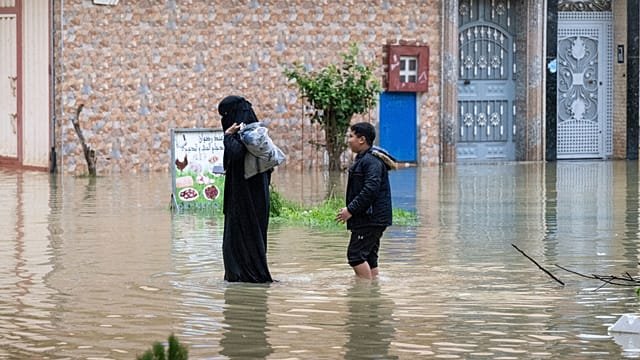
El Habachi is one of thousands displaced after two catastrophic flood emergencies battered northwestern Morocco between December 2025 and February 2026.
The extreme weather exposed the country’s acute urban flash-flood vulnerability and pushed major river basins to their limits, leaving families like his homeless during the Muslim holy month.
‘Living day to day, moment by moment’
For those in temporary shelters, the traditions of Ramadan have become painful memories.
Abdelmajid Lekihel, a 49-year-old street vendor, describes how the floods have stripped the holy month of its rhythm and joy.
“We have a tradition during Ramadan after breaking the fast. We go to the mosque or to cafés after the prayer to meet up with our loved ones,” he explains. “But this year, with the floods and these difficult days, we’re living from day to day, moment by moment. For example, even just going to get some hot water is difficult for us.”
The simplest daily tasks have become struggles, and the communal spirit that defines Ramadan evenings has been replaced by isolation and uncertainty.
‘We do not sleep’
Beyond the loss of normalcy, many evacuees live in constant fear.
Mansour Amrani, a 59-year-old security guard, says his family remains traumatized by the rising waters that nearly swallowed their home.
“We do not sleep, because we are afraid the house will collapse on our heads and on our children,” Amrani says. “We do not sleep peacefully like others who have nice houses, far from the river.”
His words reflect a lingering anxiety shared by many whose homes remain damaged or dangerously close to swollen waterways.
The psychological toll, they say, is as heavy as the material losses.
Emergency response and uncertain futures
In the aftermath of the floods, local officials visited affected neighborhoods to document damage.
Names were recorded, photographs taken, and preliminary assessments conducted.
Following High Royal Instructions issued by King Mohammed VI, authorities announced an emergency support and reconstruction programme to help families rebuild.
The plan aims to provide comprehensive assistance to populations affected by what officials describe as an unusual weather event. But for families like El Habachi’s, the wait continues.
When the floods first forced him from his village, he thought the displacement would be temporary.
Weeks later, he remains in a tent, wondering when—or if—he can return to the life he knew.
Related articles
From the same country