


14/02/2026 – 19:40 GMT+1
The Spanish president participates in the Munich Security Conference for the first time and questions the rearmament strategies of the powers. Faced with Putin, he advocates investing in values instead of nuclear arsenals.
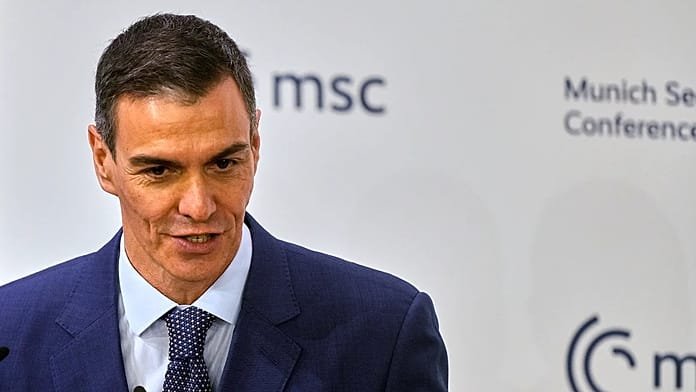
On Saturday, Pedro Sánchez stepped onto the stage of the Munich Security Conference for the first time as Prime Minister of Spain. He did so with a speech that clashed head-on with the current trend among world powers. His message was direct: nuclear rearmament will not protect anyone from Vladimir Putin.

ADVERTISEMENT
ADVERTISEMENT
The figures Sánchez used put his argument into context. The powers spend more than $11 million every hour on nuclear weapons. The US alone will spend $946 billion on nuclear weapons over the next decade.
“This is enough to eradicate extreme poverty in the world,” the Spanish president pointed out. To this, he added concern about artificial intelligence applied to the nuclear arsenal, a factor he considers particularly dangerous.
Sánchez quoted Ronald Reagan to reinforce his position: “A nuclear war cannot be won.” He did not frame the debate as an ideological question of left or right, but as a practical choice between paths that lead to real security and those that do not.
European military engagement without vassalage
Sánchez made it clear that rejecting nuclear rearmament does not mean neglecting defence. Spain has tripled its military spending and doubled its deployed troops, in his own words. He backed the creation of a true European army and assured that his country “will collaborate with whatever is necessary.”
The context of the conference was particularly tense. Europe and the United States are at one of their most divisive moments, with Marco Rubio representing the Trump administration.
Other leaders present, such as Finland’s Alexander Stubb and Denmark’s Mette Frederiksen, unambiguously advocated increasing defence spending and sending more weapons to Ukraine. Stubb even responded indirectly to Sánchez’s comments by recalling that Finland joined NATO to be a “security provider, not a consumer.”
A strong EU in the face of those who see it as a threat
The Spanish president spent part of his speech denouncing that there are sectors in the US that perceive the EU as a threat rather than a partner. “Some would like to see a more fragmented EU,” he said, although he was convinced that European countries are working in the opposite direction.
The Spanish president has been one of the most critical leaders of Donald Trump since his return to the White House. He defends the transatlantic link, but without implying what he himself has called “vassalage.” In Munich, he insisted that Europe must enlarge the Union to include Ukraine, carry out internal reforms and increase its economic competitiveness.
The conference, held since 1963, brought together some 200 government representatives from 120 countries this weekend. Sánchez was the first Spanish prime minister to take part in the forum, which this year was held amid the most serious diplomatic tensions between the two sides of the Atlantic in decades.