


Hamas leader rejects disarmament while Israeli occupation of Gaza continues
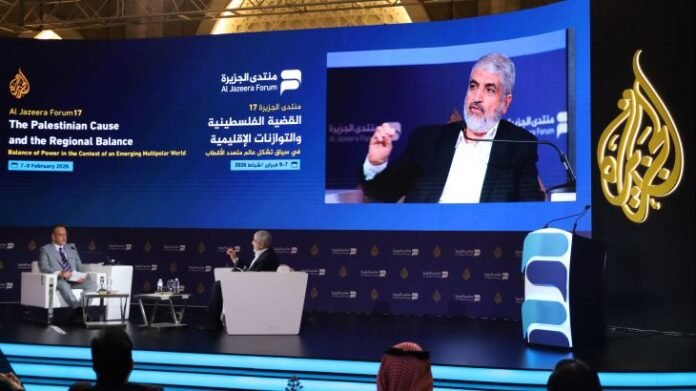
Speaking at Al Jazeera Forum, Khaled Meshaal describes discussion around Hamas handing over weapons as a continuation of a long effort to neutralise Palestinian armed resistance.

Head of Hamas abroad says ‘resistance is a right’ for occupied people
 By Al Jazeera StaffPublished On 8 Feb 20268 Feb 2026
Save
Hamas’s political leader abroad, Khaled Meshaal, has rejected calls to disarm Palestinian factions in Gaza, arguing that stripping weapons from an occupied people would turn them into “an easy victim to be eliminated”.
Speaking on the second day of the Al Jazeera Forum in Doha on Sunday, Meshaal described the discussion around Hamas handing over its weapons as a continuation of a century-long effort to neutralise Palestinian armed resistance.
Recommended Stories
list of 4 itemsend of list
“In the context that the occupation is still on, talk about disarmament will turn our people into a victim that can be easily preyed on by Israel, which is armed with all international weaponry,” he said.
“If we want to talk about it … it is necessary to provide an environment that allows reconstruction and relief and ensures that the war does not reignite between Gaza and the Zionist entity. This is a logical approach, and Hamas — through mediators Qatar, Turkiye and Egypt, and through indirect dialogues with the Americans via the mediators — has reached, or there has been, an understanding of Hamas’s vision on that. Yes, this is something that requires great effort, not an approach of disarmament.”
United States President Donald Trump last month sought to achieve a “comprehensive” demilitarisation of Hamas, threatening the Palestinian group with repercussions if it fails to do so. Hamas has refused to give up arms as long as Israel continues to occupy Gaza.
In the second phase of a US-mediated “ceasefire” deal between Israel and Hamas, agreed in October last year, Washington says it will tackle the disarmament of Hamas and the deployment of an international peacekeeping force.
Advertisement
But Israel continues to carry out near-daily deadly attacks across Gaza in violation of the “ceasefire” and has so far refused to withdraw from the so-called “Yellow Line” in eastern Gaza, an informal boundary separating more than half of the territory that remains under Israeli military control from the rest of the Strip. Israel has killed at least 576 Palestinians and wounded 1,543 others since the latest “ceasefire” started.
“The problem is not that Hamas and the resistance forces in Gaza provide guarantees; the problem is Israel, which wants to take the Palestinian weapons … and put them in the hands of militias to create chaos,” he said.

Meshaal pointed to Hamas’s proposals for an extended calm as an alternative to dismantling its military wing.
“Hamas proposed a truce of five to seven to 10 years. This is a guarantee that these weapons are not used,” he said, adding that the mediating nations, who have a “deep relationship with Hamas, can form a guarantee”.
Meshaal pointed out that if people were to go back to the origin of the conflict, the issue is one of “occupation and a people resisting occupation, with the right to self-determination and independence”.
“Resistance is a right for people under occupation; it is part of international law and the heavenly religions. Resistance is part of the memory of nations,” he added.
‘Palestinian cause must have a solution’
Meshaal said the October 7, 2023 attack on Israel was a “turning point”, arguing that the Gaza conflict forced the world to reopen a “second question” of the Palestinian cause itself.
“The [Operation Al-Aqsa] Flood and this genocidal war have shaken the world. There is now a question – the Palestinian cause must have a solution,” he said, referring to the October 2023 attack, as he welcomed a growing number of nations recognising a Palestinian state, calling the moves “insufficient”.
“The fact that 159 countries have approved or recognised the Palestinian state is good, but it is not enough. How do we turn the Palestinian state into a reality on the ground? That is the big question we are concerned with as Palestinians, as Arabs, as Muslims, and along with our friends around the world,” he said.
Meshaal called on the Arab and Muslim states to move from a “defensive policy” to “offence” in the diplomatic arena.
“We want to entrench that it is a pariah entity and a burden on security, stability, and international interests; to pursue it and turn it into an entity that loses its international legitimacy completely, just like the apartheid regime in South Africa,” he added.
Advertisement
“We are the owners of a just cause, and the accused is the one who committed the war crime of genocide,” he said.