


05/02/2026 – 14:08 GMT+1
Israeli strikes across the Strip resulted in the deaths of at least 24 people, according to health officials, as both sides accuse each other of violating the ceasefire.
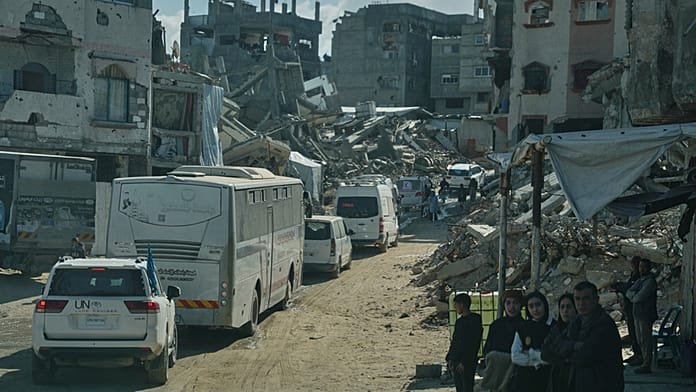
At least 24 people were killed in Gaza on Wednesday after Israeli strikes hit several locations across the Strip, according to health officials.
Israel said it killed three militant leaders and others who posed a threat to its forces, and that some strikes came in response to a Hamas attack that seriously wounded one of its soldiers.
The Hamas-run Gaza health ministry said that 21 people were killed, including three children, in a series of strikes, with at least 38 others wounded.
The territory’s civil defence agency said that two more people were killed and eight were injured in a strike on a tent in the centre of the Strip, and another person was killed in a strike that hit a group of civilians west of Gaza City.
The International Federation of Red Cross and Red Crescent Societies said it was “outraged” by the killing of an on-duty paramedic, Hussein Hassan Hussein Al-Samiri, in a bombardment in the southern Al-Mawasi area.
The Israeli military said one strike in southern Gaza had targeted a Hamas platoon commander Bilal Abu Assi who led an assault on a kibbutz during the 7 October 2023 attack on southern Israel that sparked the Gaza war.
The IDF said its strikes had also killed Ali Raziana, the commander of Hamas ally Islamic Jihad’s northern Gaza brigade, as well as Hamas’ Muhammad Issam Hassan al-Habil, accused of killing Israeli soldier Noa Marciano who was taken hostage on 7 October.
According to Gaza health officials, a total of 556 Palestinians have been killed as Israel’s repeated air strikes threatened to shatter the US-mediated ceasefire, which went into effect on 10 October. Israel’s military says four of its soldiers have been killed since the ceasefire began.
Israel has said its strikes are responses to Hamas ceasefire violations or militant attacks on its soldiers. Eight countries, including mediators Egypt and Qatar, recently condemned what they called Israel’s “repeated violations” of the deal.
The Israeli military said it had also targeted three individuals on Wednesday who approached Israeli-controlled territory behind the so-called “yellow line”.
Palestinians living near the demarcation line agreed upon by US President Donald Trump’s 20-point ceasefire deal claim Israeli soldiers direct near-daily fire at anyone who crosses or even lingers near it.
The line that the Israeli military withdrew to as part of the ceasefire deal is still unmarked in certain places and in others was laid nearly half a kilometre deeper than what was agreed to in the ceasefire deal, according to residents and international organisations.
Parts of ceasefire deal move forward
Meanwhile, some parts of the ceasefire deal have moved forward.
Hamas has released all of the hostages it was holding, and in return, Israel has released several thousand Palestinians.
However, questions remain over whether Hamas will relinquish control of the Strip or fully disarm, which remains a red line for Israel.
The Rafah border crossing’s opening Monday was also hailed as a step forward for the fragile ceasefire.
Since then, Palestinian passage through the crossing has been marred by delays, interrogations and uncertainty over who would be allowed to cross. It took the entire day Tuesday for 40 Palestinians to enter Gaza, according to humanitarian workers.
On Wednesday, 15 patients from Gaza and 31 of their relatives were scheduled to cross to Egypt, but more than half the group was turned away, said Raed al-Nims, a spokesperson for the Palestine Red Crescent Society.
The government of Egypt’s North Sinai Governorate confirmed that some had been allowed into Egypt, but did not provide figures.
Other key elements of the ceasefire appear to have stalled, including the deployment of an international security force, the formation of a technocratic Palestinian government in Gaza, and the reconstruction of the Strip.