



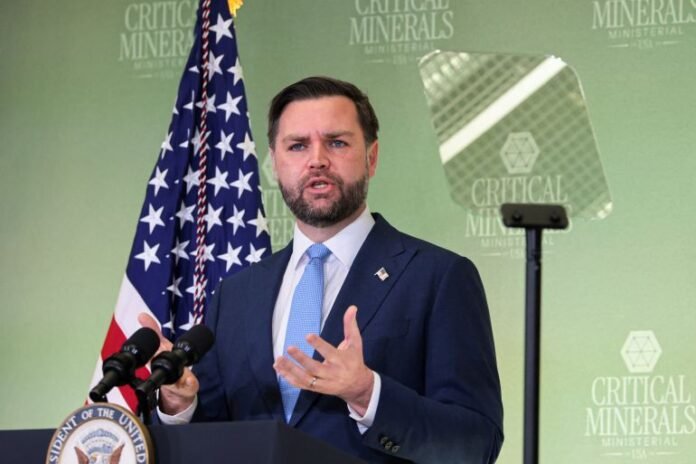
US announces proposed critical mineral trading bloc
The group would challenge China’s stronghold on the globe’s rare earth mining industry.


Published On 4 Feb 20264 Feb 2026
Save
United States Vice President JD Vance has proposed creating a new critical mineral trading bloc and coordinating pricing floors as Washington tries to loosen China’s control over rare earth mineral manufacturing.
Vance said on Wednesday that the trade war over the past year exposed how dependent most countries are on the critical minerals that China has a stranglehold on.
Recommended Stories
list of 4 itemsend of list
“We want members to form a trading bloc among allies and partners, one that guarantees American access to American industrial might while also expanding production across the entire zone,” Vance said at a meeting of foreign ministers at the US State Department.
“What is before all of us is an opportunity at self-reliance that we never have to rely on anybody else except for each other, for the critical minerals necessary to sustain our industries and to sustain growth.”
China has maintained 70 percent of the world’s rare earth mining. Critical minerals are used in key products that consumers use daily, including smartphones and cars.
“The United States is a distant second [in mining] at just 12 percent, leaving a significant gap to close. As a result, [US] President Trump spent much of 2025 meeting with leaders from Ukraine, Australia, Japan, and countries across Central and Southeast Asia to negotiate trade deals aimed at securing access to rare earths and critical minerals, efforts intended to give the US a better chance of competing with China,” Mark Temnycky, a nonresident fellow at Atlantic Council’s Eurasia Center, told Al Jazeera.
“I think a lot of us have learned the hard way over the last year how much our economies depend on these critical minerals,” Vance said at the opening of a meeting that US Secretary of State Marco Rubio hosted with officials from several dozen European, Asian and African nations.
Advertisement
South Korea, India, Thailand, Japan, Germany, Australia, and the Democratic Republic of the Congo were among the countries attending the meeting on Wednesday.
The meeting was underscored by tensions between the US and allies amid US President Donald Trump’s unsolicited attempts to acquire Greenland from Denmark.
“Denmark has been on high alert. Several countries within the NATO alliance sent troops to Greenland to strengthen and fortify the territory, and it’s very significant because it’s ruffling a lot of feathers, and making a lot of traditional US allies and partners very uncomfortable with dealings with the US,” Temnycky said.
But those tensions haven’t stopped the White House from pushing a new trading bloc.
On Monday, the White House said it will build a new critical mineral stockpile and named the plan Project Vault. Vance’s announcement on Wednesday came just as Trump held a call with China’s President Xi Jinping which he said was “excellent” but it was not clear if there was any mention of the proposed bloc.
Pricing floor
Vance also said that the US will unveil a pricing floor system that Washington hopes will unlock private investment in mining and processing projects that have struggled to compete with cheaper Chinese supply.
The approach could reshape global supply chains for materials essential to electric vehicles, semiconductors and defence systems, while raising costs for manufacturers in the short term and escalating trade tensions with Beijing.
China’s expanded export controls on rare earths last year caused production delays and shutdowns for auto manufacturers in Europe and the US, and a China-generated glut of lithium has stalled plans to expand production in the US.
“China has long played an important and constructive role in keeping the global industrial and supply chains of critical minerals safe and stable and is willing to continue to make active efforts in this regard,” China’s embassy in Washington told the Reuters news agency when asked about the meeting.
China’s leverage was on full display in October when Trump agreed to trim tariffs on Chinese goods in exchange for Beijing’s pledge to hold off on stricter restrictions on rare earths exports.
Wednesday’s gathering underscores a broader US push to work with partners to counter China’s dominance in the sector by coordinating policy tools at a time when Trump has angered allies with his sweeping “America First” tariff policies.
On Wall Street, nearly all of the critical minerals companies in which the Trump administration has taken equity stakes are seeing their stock prices tumble in midday trading. MP Materials is down more than 8 percent, Intel has fallen over 3.5 percent, Lithium Americas is off 7.6 percent, Trilogy Metals is down more than 10 percent, and USA Rare Earth has dropped 10.8 percent. Korea Zinc is the lone outlier, rising 6.5 percent.
Advertisement